
Your credit score is one of the most important factors that determine your financial credibility. Whether you’re applying for a home loan, an unsecured business loan, or even a startup loan for a new business, lenders rely on your CIBIL report to assess your repayment ability.
However, errors or inconsistencies in your report, such as incorrect personal details or wrongly reported dues, can negatively affect your score and loan eligibility. To prevent this, it’s crucial to identify and resolve any discrepancies through a CIBIL dispute.
What are CIBIL Disputes?
Credit Information Bureau India Limited (CIBIL) collects and maintains credit information of individuals and businesses. Based on this data, it assigns a three-digit CIBIL score that reflects your creditworthiness.
Sometimes, errors can appear in your CIBIL report due to incorrect information shared by lenders or data mismatches. These could involve:
- Wrong personal or contact details
- Incorrect loan amounts or repayment history
- Duplicate loan entries
- Unauthorised accounts appearing under your name
The process of correcting such inaccuracies is called a CIBIL dispute. Such disputes are categorised into two types:
- Personal CIBIL Disputes
- Business CIBIL Disputes
Both can be raised online through the CIBIL portal using the CIBIL Online Dispute Resolution Form.
Why Does Resolving CIBIL Disputes Matters?
Your CIBIL report directly impacts your access to credit. An error can:
- Lower your credit score
- Reduce your eligibility for loans or credit cards
- Increase the interest rates offered by lenders
- Delay approvals for financial assistance under government or private schemes
Resolving disputes quickly ensures your credit report reflects your true repayment history, improving your chances of getting approved for future financial needs.
Types of CIBIL Disputes
CIBIL disagreements fall into one of two categories:
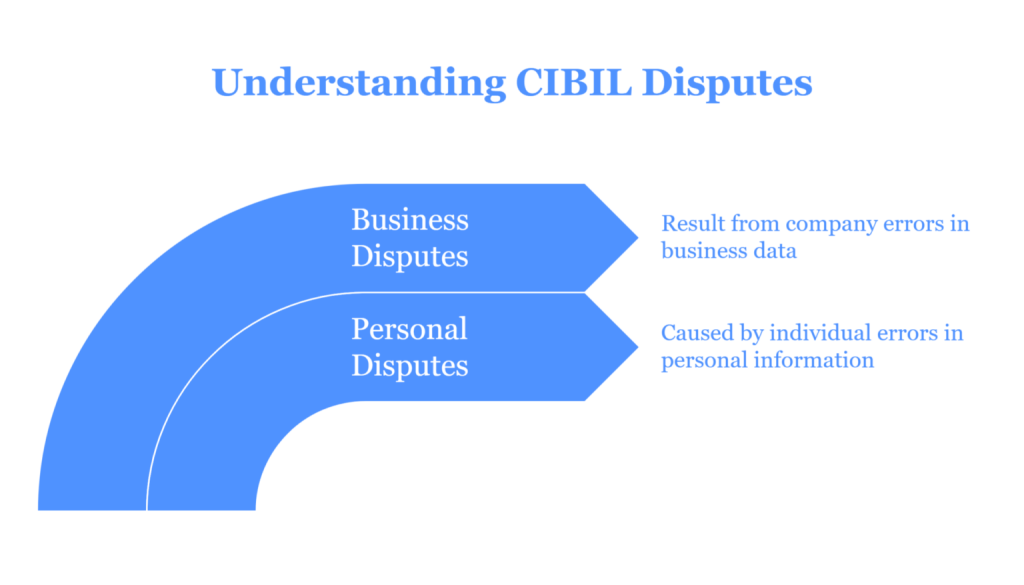
1. Personal Disputes
The individual himself contributes to several factors that lead to individual disputes. The inclusion of inaccurate personal information, such as name, age, and residence, in your CIBIL report is one of the causes of an individual dispute. Submitting the identical loan application more than once could also cause issues with duplicate accounts. This type of duplicate account error can drastically lower your credit score.
2. Business Disputes
Errors in business disputes often result from the filing of incorrect information by the corporation regarding ownership details or other inaccurate data. The company itself must submit the CIBIL score resolution form in the event of a dispute. Note that certain details like account numbers, inquiry dates, and member names cannot be changed. The official website can usually be used to resolve CIBIL score issues.
How to Check CIBIL Disputes?
Now the question arises, how would one come to know of any disputes or discrepancies in their CIBIL report? You can follow the following simple steps to check for the same:
Obtain Your CIBIL Report
To check your CIBIL score or any discrepancies or disputes in your CIBIL record, you first have to obtain your CIBIL report. This will help you verify the information which is in the record with the TransUnion. To get a credit report, you may simply visit the TransUnion CIBIL website, create an account, fill in the necessary details, and access the report instantly.
Review the Report
This is probably the most critical step in identifying the possible discrepancies in your CIBIL report. Once you have obtained the report from the TransUnion CIBIL website, you may then review the report carefully. The report would have information about your credit history, outstanding loans, and credit score. Pay attention to details like CIBIL address under each closed and active loan, name, account details, loan amount, repayment history, etc., as CIBIL takes these factors into account to calculate credit score
Identify the Discrepancy
This is the most crucial aspect of the entire process. Look for discrepancies such as incorrect names captured on the loan application, incorrect loan entries, discrepancies in repayment records, or even loan accounts that don’t belong to you. All these aspects have an impact on your credit score, and it is crucial to identify these discrepancies on time before they damage your score to a great extent.
Raise a Dispute
In case you notice any kind of discrepancy in your CIBIL report, you have the option of raising a dispute through the CIBIL portal. Log in, go to “Dispute Resolution,” select the item in question, and provide supporting evidence (e.g., payment receipts or loan closure letters). TransUnion CIBIL will process the dispute and conduct an inquiry into the issue, which usually gets completed in 30–45 days. Once the case is cleared, your report is updated reflecting your correct credit history.
How to Raise a CIBIL Dispute Online?
CIBIL offers multiple convenient ways to raise and resolve disputes. Here are a few:
1. MyCIBIL’s Dispute Resolution System
- You must first access myCIBIL on the official CIBIL website. Click “Raise a dispute.”
- Choose the relevant account or section with incorrect details.
- Enter the correct information and submit.
- You can select “Duplicate Account” or “Ownership Dispute” under dispute type if needed.
2. CIBIL Online Dispute Resolution Form
If you don’t have a myCIBIL account, you can fill out the CIBIL Online Dispute Resolution Form directly on their website. A separate form is available for business credit disputes. This method is quick and doesn’t require logging in.
3. Offline Dispute Resolution
The offline procedure is sending a letter to the CIBIL office in Mumbai. This correspondence must precisely list the transaction ID, report registration number, and complete details of your concern.
Dispute Resolution Process
The following steps comprise the CIBIL dispute resolution process:
- The issues that you have brought up are marked as “In Dispute.”
- The different dispute categories are separated and delivered to the appropriate credit institution to be thoroughly investigated.
- Depending on the nature of the issue, CIBIL will then get in touch with the relevant lender.
- The lender evaluates the dispute and, based on the investigations, decides whether to accept it or reject it.
- Then, CIBIL receives this information.
- If the lender denies the claim, the case is withdrawn; however, if it is validated, CIBIL updates the inaccurate data.
- Once the problem has been resolved, the “Under Dispute” label is deleted.
It could take up to 30 days to complete this process. You will be informed by CIBIL about the dispute resolution, and adjustments will be made to the CIBIL Report as necessary.
Exceptions in CIBIL Disputes
There are certain exceptions to the dispute resolution process, even though you can lodge a CIBIL dispute for most inconsistencies detected in your CIBIL report. By submitting a correction request, you cannot alter some information.
The specifics listed below are not subject to dispute:
- Request date
- Date of report
- Customer number (if not an ownership dispute)
- Username (if not an ownership dispute)
- Control code
Things to Remember When Raising a CIBIL Dispute
To ensure a smooth and effective resolution:
- Verify the Discrepancy: Before submitting a dispute, it is imperative to ensure that the discrepancy is genuine. It is recommended to cross-verify the dispute between the company credit report / personal credit reports with loan documents to ensure that you’re submitting the correct dispute claim.
- Gather Supporting Documents: To ensure that your dispute gets successfully resolved, it is essential that you provide the TransUnion CIBIL authorities with enough evidence that can back up your claim of discrepancy in the CIBIL report. These supporting documents can include loan documents, personal documents, etc. Depending on the type of discrepancy, they will help CIBIL effectively address consumer dispute resolution.
- Be Specific: While filing for a dispute, it is important to ensure that you point out the discrepancy accurately. Vague remarks about the discrepancy can lead to dispute claim rejection or delayed resolution. Hence, to make the job easier for the credit dispute resolution team clearly mention what is incorrect, provide supporting proof wherever possible, and outline what the correct value should be. The more precise your inputs are, the faster and smoother your dispute can be reviewed and resolved.
- Use the Correct Dispute Category: Incorrectly selecting the dispute category often leads to claim rejection. It is recommended to cross-check your credit score and file the dispute under the correct category to avoid rejection.
- Keep Track of the Dispute Status: You can do this by actively checking the dispute status with the help of the CIBIL portal. You may also keep the credit bureau contact details for any help.
- Ensure Accurate Contact Details: Double-check that your email address and phone number are up-to-date with the CIBIL authorities, as they will use these to communicate regarding dispute resolution. These details may also be used to access your CIBIL report online in the future.
- Stay Patient: Credit bureau dispute resolution can sometimes take longer than anticipated. It is recommended to be patient, as the CIBIL bureau conducts all necessary checks and balances to ensure that the correct details are updated in the record. This process can sometimes take time.
How CIBIL Disputes Impact Loan Approvals
Unresolved CIBIL disputes can lower your score, making it harder to qualify for loans. For instance, if you’re applying for an MSME loan scheme, an inaccurate CIBIL report might delay or reduce your chances of approval.
Similarly, entrepreneurs seeking a startup loan for a new business or an unsecured business loan should ensure their credit report is accurate before applying. Lenders depend heavily on your CIBIL score to evaluate creditworthiness. This is why it is important for you to know how to raise dispute in CIBIL.
Conclusion
Your ability to obtain new credit, whether as an individual or business, is heavily influenced by your credit report. Any inaccuracy, no matter how small, can reduce your chances of securing funding or increase the cost of borrowing. That’s why it’s so important to review your credit report regularly and raise a CIBIL grievance or dispute as soon as you notice an error.
At LendingKart, we understand the importance of a good credit score for every individual and business owner. We aim to simplify and expedite access to finance for entrepreneurs across India. Through our seamless online process, you can apply for a business loan without unnecessary paperwork or delays. We also encourage every borrower to stay informed about their credit health, because maintaining a clean and accurate CIBIL record ensures better approval chances and more competitive loan terms.
By helping you understand your credit report and providing flexible funding options, we’re here to support your journey toward financial confidence and success.
CIBIL Dispute FAQs
1. How can a dispute be raised with CIBIL?
For mistakes, account ownership, and duplication of information that appears in your credit report, you can now open a dispute with CIBIL online. Customers of CIBIL are not charged for this service.
2. What is the ETA for dispute resolution?
When the CI responds to the dispute request, CIBIL updates the changes immediately (if applicable) and sends you an email to notify you of the progress. Subject to the credit institution’s response time, a dispute may be resolved within approximately 30 days.
3. Is it possible to remove a dispute from the credit report?
You can contact the credit bureau reporting the dispute if you wish to have it removed from your credit report (for free). The phone numbers 888-210-9101 and 866-673-0140 for Experian are answered by live people. Just let them know you need to resolve the disagreement through the National Consumer Help Center(s).
4. Can a low CIBIL score affect my business loan approval?
Yes, lenders check your CIBIL score before approving a loan. A low score can reduce your chances of getting approved or result in higher interest rates, especially for products like unsecured business loans or startup loans for new businesses.
How to Check CIBIL Score Using PAN Card for Free
Business Loan for Low CIBIL Score or Bad Credit
How to Improve your CIBIL Score Immediately?
Company Credit Report (CCR) – Improve CIBIL Rank & Report for Company
What is a Good CIBIL Score to Get a Loan?
How to Check and Improve CIBIL Credit Score for Business Loan?
CIBIL Score for Business Loan – Check Minimum Credit Score
CIBIL Dispute FAQs:
Learn More:
Working Capital Loan EMI Calculator
Difference Between Working Capital Loan and Term Loan
Loan for Chartered Accountants
Accounts Receivable Financing
Best Free Accounting Software for Small Business
Difference between tin tan vat pan dsc and din
epf balance
form 15g
Fssai License
Business Ideas for Women
10 Business Ideas after Lock Down
Business Skills are Needed to Run Business
Business loan for women
Agriculture business plan
Dairy farm loan
Mudra Loan
Small Scale Industries in India
GST Registration Online
Aadhar Card Status
PAN Card Correction & Update
Aadhaar Card Download
PAN Card Apply Online
Instant PAN Card through Aadhaar
PAN Card Mistakes – To Avoid
How to Link Aadhaar with PAN Card
PAN Card Details Search By Name, DoB, PAN Number & Address
What is a Cancelled Cheque
Related Articles
 CREDIT SCORE BLOGS
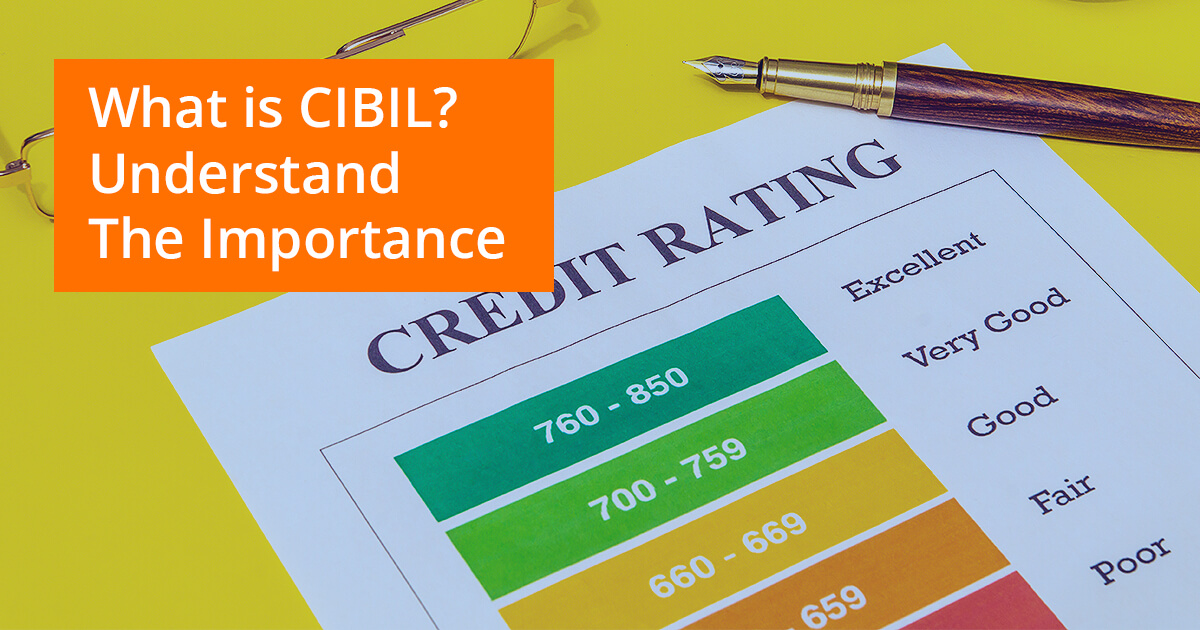
What is CIBIL Score?
Understand what a CIBIL score is, how it’s calculated, and why it plays a key role in loan eligibility.
 CREDIT SCORE BLOGS
Commercial vs Consumer CIBIL
Explore the key differences between commercial and personal CIBIL reports and how they impact credit decisions.
 CREDIT SCORE BLOGS
CIBIL Score for Business Loan
Learn how your CIBIL score influences business loan approvals and what lenders look for in credit profiles.