

Gone are the days when sending money to another person involved the tedious use of money orders or cheques. Now, with the advent of digital and electronic banking across India, you can transfer amounts seamlessly to another bank account in real time. This has been possible since 2004, when the Reserve Bank of India (RBI) introduced the RTGS fund transfer facility.
It was the first mode of electronic funds transfer introduced in India. Following this, National Electronic Funds Transfer (NEFT) was made available in 2005 and Immediate Payment Service (IMPS) in 2010.
This blog will explain what is RTGS, help you understand how it works, and explore the features of RTGS in detail.
What is RTGS Payment?
RTGS stands for Real Time Gross Settlement. As the name indicates, it is a method of transferring money electronically from one bank account to another on a real-time basis. This is the key differentiating factor of RTGS fund transfers. Unlike bank credit transfers, cheque clearances, and even NEFT payments, all of which are settled in batches, RTGS transactions are processed and settled individually.
Given the immediate transfer involved, the typical RTGS transaction time is practically zero. This makes RTGS the preferred option for anyone who wants to transfer funds immediately to another bank account.
How Does RTGS Work?
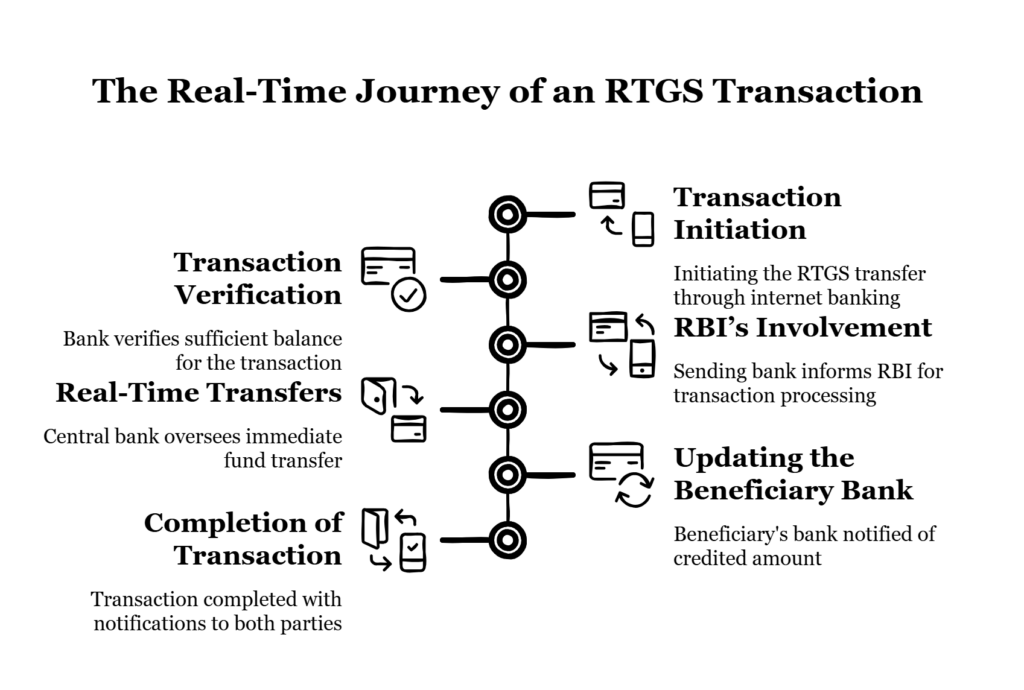
The process involved in RTGS bank transfers is fairly different from the NEFT process or other fund transfer channels. This is because RTGS does not involve batch transaction processing. Let us take a closer look at the steps in how Real Time Gross Settlement works.
Transaction Initiation
The process of an RTGS transfer begins when you initiate the transaction through your bank’s internet banking portal. To do this, you need the beneficiary’s account details, including their name, bank name, bank branch, account number, and IFSC code.
Transaction Verification
When you initiate an electronic funds transfer via RTGS, your bank verifies whether you have a sufficient balance in your account to carry out the transaction. This is crucial because RTGS transfers are typically larger transactions.
RBI’s Involvement
The sending bank then sends an intimation to the Reserve Bank of India that the transaction can be implemented successfully. The RBI then ensures that the amount is transferred from your account to the beneficiary’s account without any hassle.
Real-Time Transfers
The central bank is responsible for overseeing the real-time transfer of the correct amount from one bank account to another. Each transaction is carried out as and when the request is placed. There is no waiting time or grouping of RTGS transfer transactions into batches.
Updating the Beneficiary Bank
The central bank also notifies the beneficiary’s bank (or the recipient bank) about the amount that is to be credited as part of the RTGS funds transfer. This ensures that all parties to the transaction are kept updated.
Completion of Transaction
The transaction is then completed successfully. The sending bank notifies you, the sender, that the amount has been debited from your account. Meanwhile, the recipient bank notifies the beneficiary that the amount has been credited to their account.
Key Details You Should Know About the RTGS Payment Method
Once you know how RTGS works, the next step is to understand its practical aspects, such as fees, timing, and transfer limits.
Transaction Charges
Inward RTGS transfers are free for the recipient of the funds. However, banks may levy a charge on outward RTGS bank transfers. Fortunately, these charges have been capped by the Reserve Bank of India as follows:
- For RTGS transfers between ₹2 lakh and ₹5 lakh: Service charges up to ₹25 + tax
- For RTGS transfers over ₹5 lakh: Service charges up to ₹50 + tax
RTGS Timings
While RTGS bank transfers had strict time limits earlier, the facility is now available 24/7. This means you can initiate a transfer through the RTGS channel at any time during the day or night. The facility is also available on banking holidays and weekends, so you can make your payments and send or receive money without any restrictions or hassle.
RTGS Transaction Limits
Unlike many other transfer methods, RTGS comes with a minimum limit. You need to transfer at least ₹2 lakh to use this electronic method. This is why RTGS bank transfers are best suited for high-value transactions. While the RBI has not specified an upper limit, some banks may impose a maximum daily limit on transfers via their internet banking portals.
What are the Key Features of RTGS?
Transferring money via RTGS is highly preferred because of its distinct characteristics. The key features of Real Time Gross Settlement include the following:
Secure Fund Transfers
Electronic fund transfers via RTGS are extremely secure. This is because such transactions are monitored by the Reserve Bank of India. The servers used to support these transfers are highly secure and designed to reduce issues like fraud and hacking. Data encryption also ensures that no unauthorised third parties can access the information.
Gross-Based Clearing
Transferring funds from one bank account to another via RTGS occurs on a gross, per-transaction basis. The transfers are not clubbed into batches and processed at specific intervals. Instead, they are processed individually, on a real-time basis. This means that the waiting time for your funds to be transferred is greatly reduced due to instant transactions.
Different Methods of Transfer
RTGS bank transfers can be done in many ways. You can log into your internet banking portal to initiate an RTGS transaction. Alternatively, you can also transfer funds via RTGS using your bank’s mobile banking application. In addition to this, offline RTGS transfers are also possible at bank branches.
Specific Details Required
To ensure that your electronic funds transfer via RTGS is successful, you need to submit all the details needed. This includes the beneficiary’s name, bank name, bank branch, and account number. In addition to this, you also need to provide the correct IFSC code, the amount to be transferred, and the purpose of the transfer.
What are the Benefits of RTGS?
There are many reasons why RTGS is considered to be one of the best ways to transfer money between banks. Its key benefits include the following advantages:
- Quick Fund Transfers: Since the transfer occurs in real time, the money is sent to the recipient’s account quickly. This helps the sender and the receiver save time.
- Secure Transfers: RTGS transfers offer high levels of security. They are monitored by the central bank and are safe for the sender and the receiver.
- Lower Risk of Fraud: Immediate and real-time transfers mean that the risk of fraud is highly reduced. Once the funds are sent, the transaction is final and complete.
- Reduced Default Risk: Since transactions are settled individually, the risk of default is also greatly reduced. Receivers can ensure that the funds are credited to their account right away.
- Supports High-Value Transfers: RTGS is primarily suited for high-value transfers. This includes commercial and personal transactions with values of ₹2 lakh or more.
- 24/7 Availability: RTGS is available round-the-clock. So, you can send and receive money instantly on any day of the week, including weekends and bank holidays.
Conclusion
All things considered, RTGS bank transfers are highly secure alternatives for anybody who wants to send or receive large amounts of money immediately. They are best suited for emergency transactions, too. So, if you want to send amounts of ₹2 lakh or higher, this can be an excellent alternative to consider. You must, however, ensure that you submit the required details to initiate the transaction.
Frequently Asked Questions
1. What is RTGS payment and how does it work?
RTGS stands for Real Time Gross Settlement and is a method of transferring large sums of money instantly between bank accounts. The transactions are settled individually and in real time, without any batching. It’s overseen by the Reserve Bank of India, ensuring a highly secure and fast transfer process.
2. What is the minimum amount required for an RTGS transfer?
To use RTGS, the minimum transfer amount must be ₹2 lakh. This makes RTGS ideal for high-value business or personal transactions. There is no upper limit set by the RBI, but individual banks may have daily caps.
3. Is RTGS available 24/7, including weekends and holidays?
Yes, RTGS is now available 24×7, including weekends and banking holidays. You can initiate transactions at any time through the internet or mobile banking. This makes RTGS highly convenient for urgent fund transfers.
4. What details are required to make an RTGS transaction?
To initiate an RTGS transfer, you need the beneficiary’s name, bank name, branch, account number, and IFSC code. You must also provide the amount and purpose of the transfer. Accurate details ensure that the funds are transferred securely and instantly.
5. What are the benefits of using RTGS for fund transfers?
RTGS offers real-time, secure, and irreversible fund transfers, reducing the risk of fraud and defaults. It is best suited for high-value payments with immediate settlement. Additionally, RTGS transactions are monitored by the RBI, adding an extra layer of trust and security.