In today’s fast-paced digital landscape, financial transactions are increasingly being carried out electronically. Despite the rise of UPI, NEFT, and RTGS, the cheque continues to hold its ground as a vital financial instrument, particularly in the world of business. Many individuals and businesses throughout the country still rely on and even prefer using cheques for specific types of transactions.
If you are a business owner or someone who frequently handles significant financial transactions, a thorough understanding of this payment method is essential for sound financial management. In this blog, we will understand what is cheque, delve into the distinct advantages and disadvantages of cheques, explore the different types you may encounter, and offer best practices for using them securely and effectively in your business operations.
What is a Cheque?
A cheque is a type of negotiable financial instrument used to make payments from a bank account. It essentially instructs your bank to pay the specified sum of money from your account to the mentioned individual or entity.
Every bank cheque has a few basic components. Understanding what they are can help you make seamless financial transactions. The basic components of a cheque are:
- Drawer: The drawer is the individual or entity who issues the cheque.
- Payee: The payee is the individual or entity to whom the cheque is issued.
- Drawee: The drawee is the bank that is instructed to make the payment to the payee.
- Amount: The amount refers to the sum of money to be paid to the payee mentioned on the cheque. It is written in both figures and words on the cheque to avoid ambiguity.
- Date: The date refers to the date on which the cheque is issued. A standard cheque has a validity of three months from the date of issuance, meaning it must be presented to the bank for payment within this period.
- Bank Details: Every cheque includes the details of the issuing bank, including its name, branch, IFSC, MICR, and the account number of the drawer.
- Signature: The drawer must affix their signature in the relevant space to authorise the financial transaction.
What are the Types of Cheques?
To fully grasp the advantages and disadvantages of cheques, it is crucial to understand how many types of cheque there are. The type of cheque transaction used can significantly impact its security and how it is processed.
Bearer Cheque
This is a cheque that is payable to any person who presents it for payment over the bank counter. It does not require an endorsement and is risky because if lost, it can be cashed by anyone.
Order Cheque
An order cheque is payable only to the person or entity named on the cheque (the payee) or to whomever they ‘order’ it to be paid. The payee must endorse the cheque (sign the back) to transfer it to someone else or to deposit it.
Crossed Cheque
A crossed cheque has two parallel lines drawn across the top-left corner. This acts as an instruction to the paying bank to deposit the money directly into a bank account and not to pay it in cash over the counter. This provides an additional layer of security, as the transaction is recorded in both the drawer’s and the payee’s bank statements.
Account Payee Cheque
For even greater security, the words ‘Account Payee’ or ‘A/C Payee’ are written between the two parallel lines of a crossed cheque. This is the most secure type of cheque, as it can only be deposited into the bank account of the named payee and cannot be endorsed or transferred to anyone else. For business transactions, this is the highly recommended format.
Post-Dated Cheque (PDC)
This is a cheque issued with a future date. The bank will not honour the cheque until that date arrives. PDCs are commonly used in business for future payments, such as loan EMIs, rent, or supplier payments, helping to manage cash flow.
Historical Context and Evolution of Cheques
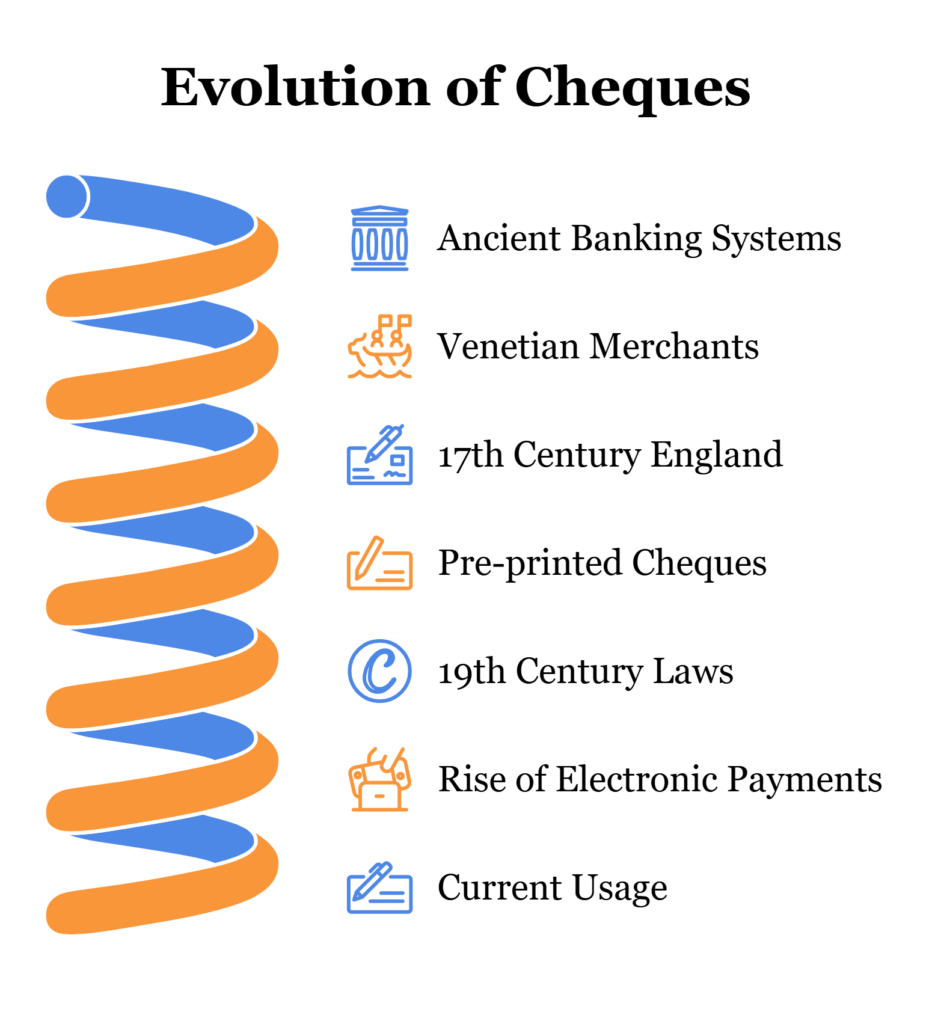
The concept of cheques dates back to ancient banking systems during the times of the Mauryan and Roman Empires. In the 13th century, merchants in Venice were paying with cheques when travelling to far-off places, which helped them avoid the hassle of carrying cash or gold.
As banking became more organised, cheques also evolved. In the 17th century, they started to become more common, especially in England. Back then, cheques were completely handwritten and were known as ‘drawn notes’. However, in 1717, the Bank of England came up with pre-printed cheques to avoid cheque fraud.
In the 19th century, many countries, including India and the UK, passed laws officially recognising cheques as a method of payment. However, with the rise of electronic payment options, the usage of cheques has declined significantly. Despite this, individuals and businesses continue to use them for formal financial dealings.
Advantages of Using Cheques
Although they might not be as versatile or quick as electronic transfers, cheques provide several benefits, even in this age of digital transactions. Here is a detailed look at some of the key advantages of cheques.
A Tangible Record of Payment
One of the biggest advantages of cheques is the clear financial record they create. Each cheque payment is recorded in your bank statement, which makes it easier to track your expenses and the movement of funds. For businesses, this creates an invaluable paper trail for accounting, auditing, and tax purposes. In case of disputes or legal issues regarding payments, a cashed cheque can serve as proof of payment, protecting both the drawer and the payee.
Enhanced Security for Transactions
Cash always has an element of risk since it can be lost or stolen. Cheques are a more secure payment option, as only the specified payee on an ‘Account Payee’ cheque can receive the funds, which prevents unauthorised individuals from accessing your money. Additionally, if a cheque is misplaced or stolen, you can simply instruct your bank to issue a ‘stop payment’ order, immediately protecting your funds.
Convenient for Large-Value Payments
Making or receiving large payments in cash is both risky and inconvenient. Cheques, meanwhile, provide a safer and more convenient way to make high-value transactions. This is particularly relevant for major business payments, down payments on property, purchasing equipment for your MSME, or settling business loan amounts.
Facilitates Post-Dated Payments
Managing cash flow is a critical challenge for many businesses. Cheques offer a unique solution through post-dating. You can schedule payments in advance by writing a future date on a cheque. Since the bank will only honour the cheque on or after the mentioned date, post-dating is particularly useful for managing recurring expenses, paying suppliers on agreed-upon dates, or handling loan instalments without needing an automated debit setup.
No Internet or Digital Literacy Required
One of the major security features of cheque is that, unlike electronic payment options, paying with cheques does not require any access to the internet or digital payment platforms. This makes them an inclusive and accessible payment option in areas with poor internet connectivity or for individuals who are not comfortable using digital banking services.
Cost-Effectiveness
Compared to some e-payment options that charge transaction fees, cheques are a highly cost-effective way to transfer money. Banks usually do not levy any kind of fees for standard cheque processing. While charges may apply for ordering new chequebooks or for special instructions like ‘stop payment’, the core transaction is generally free, making paying with cheques an affordable alternative for many.
Disadvantages of Using Cheques
Although cheque payments have many advantages, they are not without drawbacks. Here is a quick overview of some of the key disadvantages of cheques.
Significant Processing Time
Unlike most online payment options, which are processed instantly, cheques require time to clear. Even with the introduction of the Cheque Truncation System (CTS) in India, which digitises the cheque image for faster processing, it can still take one to two business days for the funds to be credited. This delay in processing can be highly inconvenient, especially for businesses that require instant fund transfers to manage their working capital effectively.
Risk of Dishonour (Bounced Cheque)
The risk of dishonoured cheques is a significant disadvantage for any business. A ‘bounced cheque’ occurs when the paying bank refuses to honour the payment, most commonly due to insufficient funds in the drawer’s account. However, cheques can also be dishonoured for other reasons, such as a mismatch in the signature, overwriting on the cheque, or if it is post-dated.
For a business that relies on timely payments, a bounced cheque can severely disrupt cash flow and create administrative headaches.
Vulnerability to Fraud
Although banks have verification systems in place, cheque fraud remains a serious issue. Fraudsters can use methods like forgery (copying a signature), alteration (changing the amount or payee name), or ‘cheque washing’ (using chemicals to erase the ink). These manipulations can lead to unauthorised withdrawals from your account.
Declining Acceptance
With the availability of reliable instant payment processing systems, many individuals and businesses have moved away from cheques. As a result, the acceptance of cheques has declined significantly. The delay in fund clearance and the inherent risk of a cheque bouncing have prompted many merchants and service providers to no longer accept them as a valid form of payment.
Physical Handling and Administrative Burden
Cheques are physical documents that need to be handled carefully and stored securely to prevent damage or unauthorised use. For a business that handles a large volume of payments, managing, storing, and reconciling multiple cheques can quickly become a cumbersome administrative burden. Retrieving cheque-related information from physical files is also far more time-consuming compared to accessing digital payment records.
Digital Alternatives to Cheques
Now that you are aware of the pros and cons of cheques, let us now explore some of the electronic alternative payment options to this traditional financial instrument.
Online Banking Transfers
The advent of internet banking introduced several online bank transfer methods that allow you to transfer funds instantly to any bank account without the need for a physical cheque. Some of the most popular online bank transfer services include the National Electronic Funds Transfer (NEFT), Real-Time Gross Settlement (RTGS), and Immediate Payment Service (IMPS).
These services allow you to make real-time payments and enhance financial transparency by creating digital records of all transactions.
Mobile Payment Apps
The Unified Payment Interface (UPI) is another one of the more attractive alternative payment options to cheques. Mobile payment applications like Google Pay, PhonePe and Paytm use UPI to send and receive payments instantly through smartphones.
Financial transactions through such mobile payment apps are highly secure, as they utilise UPI PIN authentication and biometric verification to reduce the risk of fraud or unauthorised transfers. Moreover, payment through UPI and other mobile payment apps is increasingly being accepted by most merchants, businesses, retailers, and service providers compared to cheques.
Credit and Debit Cards
Debit and credit cards are another easy and instant alternative payment option to cheques for making purchases, paying bills, and transferring funds. Debit cards deduct money directly from your bank account and ensure immediate settlement without the risk of bounced payments. Credit cards, meanwhile, offer a more flexible way of making payments, acting as a short-term credit line.
Automated Bill Payments
In recent times, many digital payment platforms have started to offer automated bill payment services. These services enable you to schedule payments for recurring expenses such as rent, utility bills, insurance premiums, and loan EMIs.
Instead of writing post-dated cheques or manually remembering payment due dates, you can use these services to auto-debit the amount from your account on a specific date. With automated bill payment services, you can completely eliminate the risk of missed payments, late fees, and the inconvenience of manually writing out a cheque.
Conclusion
Cheques have long been a reliable payment method and come with their fair share of advantages and disadvantages. However, with instant payment processing and mobile payment solutions becoming more accessible, cheques are slowly losing their relevance in modern society.
For modern businesses and individuals, the key is not to abandon cheques entirely but to understand their specific use cases. By being aware of both the advantages of cheques and the superior efficiency of digital alternatives, you can make informed and strategic financial decisions. As your business grows, these sound financial practices become even more critical, especially when seeking capital for expansion.
For a simple and quick way to secure the funds your business needs to thrive, consider partnering with a reliable lending partner like LendingKart, which offers tailored business loans to support your journey towards success. Explore LendingKart’s business loan options today and take your MSME to the next level!
People Also Ask
- What are the legal consequences of a cheque bouncing in India?
A cheque bouncing due to insufficient funds is a criminal offence under Section 138 of the Negotiable Instruments Act, 1881. The drawer (person who wrote the cheque) can face a prison sentence of up to two years, a fine of up to double the cheque amount, or both. The payee has the right to initiate legal proceedings against the drawer after sending a formal notice.
- How long is a cheque valid for?
In India, a cheque is valid for three months from the date written on it. After this period, banks will not honour it. It is crucial to present a cheque for payment within this timeframe.
- What is the safest way to issue a cheque for a business payment?
The most secure method is to issue a crossed ‘Account Payee’ cheque. You do this by drawing two parallel lines on the top-left corner and writing ‘A/C Payee’ between them. This ensures the amount will only be credited to the bank account of the person or entity named on the cheque, making it the safest option against fraud or loss.
- Can I cancel a cheque after I have already issued it?
Yes, you can. If the cheque has not yet been processed by the bank, you can issue a ‘stop payment’ instruction. You will need to contact your bank via your net banking portal, customer service, or by visiting a branch and provide the specific cheque number. Banks usually charge a nominal fee for this service.
Related Articles

GST Advantages and Disadvantages
Explore the key benefits and challenges of GST implementation for businesses, and how it impacts compliance and taxation.
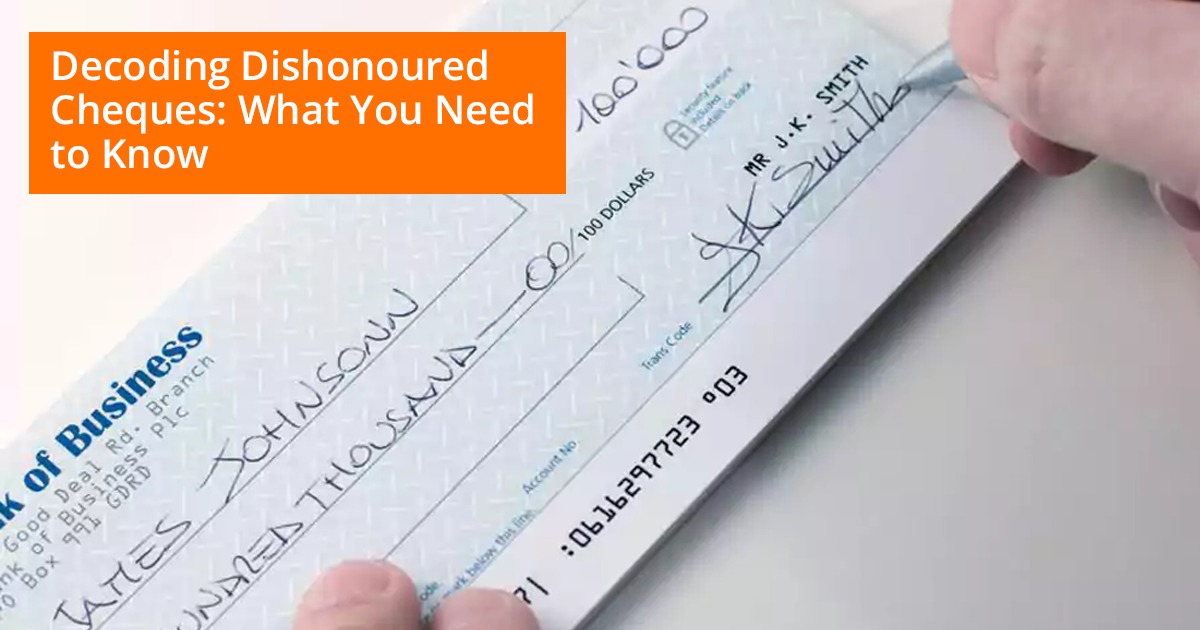
Dishonoured Cheques
Understand the reasons behind dishonoured cheques, legal consequences, and steps to resolve cheque bounce issues effectively.
Advantages of Taking a Business Loan
Discover how business loans can provide financial stability, support expansion, and help manage working capital efficiently.