

Every successful business is born from a vision. As an MSME owner, that vision might be expanding your operations, upgrading to new technology, or launching a groundbreaking new product. But turning vision into reality almost always requires capital. While the modern financial landscape offers quicker access to funds than ever before, a crucial document often stands between you and the financial assistance you need: the Project Report.
Think of your project report as the formal business plan you present to a lender. It is your single most important tool to convince them that your vision is not just a dream, but a viable, profitable, and well-thought-out venture worthy of their investment. A poorly constructed report can stop your application in its tracks, whereas a compelling, detailed report can unlock competitive interest rates and secure the loan that will fuel your growth.
This blog will walk you through exactly what is project report, its undeniable importance, and the key components you must include to build a powerful case for your business.
What is Project Report for a Business Loan?
First, let’s clarify what is project report in this context. It’s not a simple progress update or a technical document. For a lender, a project report is a detailed document that presents a complete and systematic overview of your business plan. Its primary purpose is to provide lenders with all the necessary information to assess the feasibility, financial viability, and potential risks of your project before they approve a loan.
In essence, this report answers the fundamental questions every lender has:
- What is the business or project about?
- Who are the people driving it?
- Is there a genuine market for its products or services?
- How will it generate profit?
- Most importantly, how will it repay the loan?
A common mistake is to make the report excessively lengthy. Lenders are busy; they value precision and clarity. Your goal is to be comprehensive yet concise, providing a clear and convincing snapshot of your business.
Types of Business Project Report
Different reports serve distinct functions, supporting various needs of project management reports.
- Status Report: Provides updates on progress, risks, and budget consumption. It compares planned vs. actual performance, ensuring alignment with the project on track strategy and enabling corrective actions.
- Progress Report: Highlights completed milestones and pending tasks. It assesses adherence to the project schedule and identifies if teams need additional support, ensuring project team performance efficiency.
- Feasibility Report: Evaluates a project’s viability before execution, covering expenses, risks, and projected profits. Decision-makers use feasibility studies to determine project continuation.
- Risk Report: Outlines potential threats and mitigation strategies. It assesses financial, operational, and market risks, using time monitoring techniques for proactive risk management.
- Technical Report: Covers engineering, IT, or research-based projects requiring in-depth technical analysis. It aids professionals in applying modern tools and ensures knowledge transfer.
- Final Report: Summarises project successes, challenge,s and outcomes. It documents insights for future improvements and serves as an audit tool for analysing project management professional strategies.
How to Create a Project Report?
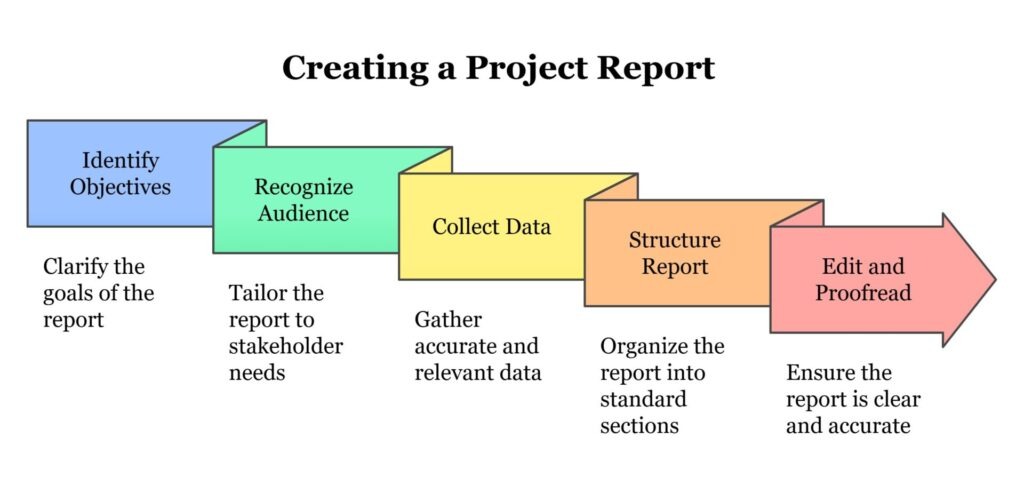
After understanding what is project report, it is also important to know how to create one. When a project report is well-structured, it ensures better project tracking capabilities and enables teams to implement insights for future projects. Various modern project management tools help in structuring the contents of project report for efficiency.
Know Your Objectives
Before drafting the content for project, clarify your goals, whether to explain findings, provide project status updates, or propose solutions. Setting clear objectives ensures a structured business project report guide that aligns with project goals. Additionally, identifying key steps facilitates effective project summary writing, leading to a better understanding.
Recognise Your Audience
Different stakeholders require different reporting styles. A properly structured project summary report ensures clarity, catering to diverse audiences. Tailoring your content based on the reader’s needs ensures effective communication.
Data Collection
A report gains credibility when backed by data, including project risk report insights, budget analysis, and progress metrics. Tools such as project time tracking software help in gathering real-time data for accuracy. Additionally, integrating surveys, interviews, and time tracking reports enhances report reliability.
Structure Your Report
The project report format typically includes a project overview, introduction, analysis, and conclusion. The phase of project management determines the depth of analysis in each section. Its format improves decision-making and helps track the overall project status effectively.
Edit and Proofread
A polished report improves readability and ensures factual accuracy, especially when discussing project expenses or compliance details. Collaborating with team members enhances and strengthens report quality.
Is a Business Loan Project Report Necessary for Acquiring Funds?
The requirement for a loan project report varies depending on factors such as loan amount and the lending company’s policies. Many lending companies offer loans without a project report for a significantly higher amount, while others don’t.
For instance, acquiring funds under Mudra Loan at Lendingkart requires a business loan project report, while for an SME loan, a project report is not mandatory.
Scope of the Project
Preparing a business loan project report needs to be done with an approach to convince the lender to believe in your dreams. Create a compelling report featuring the scope of the project, like its vision, target audience, expansion strategies, marketing ideas, and financial planning.
Project Report Details
The format of a project report varies depending on the loan type, lender, and business type. As a loan applicant, you must create a project that features the necessary details of your business operation and financials in the simplest way.
What are the Components of a Project Report?
While the exact format can vary, here are the essential components of a project report that every MSME owner should include to impress lenders. Getting the contents of your project report right is crucial for success.
Executive Summary and Introduction
A concise overview of the entire report. Think of it as the whole story on a single page. It should briefly cover your business concept, the loan amount requested, and key financial highlights. The introduction or cover page should also include basic details like your company name, logo, and the project title.
Why Does it Matter?
Many loan officers read this section first to decide if the rest of the report is worth their time. It must be powerful and compelling.
Promoter and Management Team Details
A section dedicated to the people behind the project. Provide details on the founders’ and key management personnel’s qualifications, relevant experience, past achievements, and their roles in the project.
Why Does it Matter?
Lenders invest in people as much as they invest in ideas. This is your chance to build trust and prove you have the right team to execute the vision.
Project Outline and Business Overview
This is where you introduce your business in detail. Describe your industry, the nature of your business (manufacturing, service, etc.), your mission, vision, and legal structure. Highlight your market position, operational area, and any significant milestones you have already achieved.
Why Does it Matter?
It provides the lender with the foundational context needed to understand the rest of the report.
Details of Prospects and Market Analysis
This section proves that there is a demand for your product or service. You should detail your target audience, the size of the market, your primary competitors, and your unique selling proposition (USP). Include your marketing and sales strategies.
Why Does it Matter?
A great idea is worthless without a market. This section shows that your business is not operating in a vacuum and has a clear path to attracting paying customers.
Infrastructure and Operational Plan
Detail the physical and technical resources required for your business. This includes information about your office, factory, machinery, technology, and suppliers. Outline your operational workflow, from procurement to production to delivery.
Why Does it Matter?
It demonstrates that you have a tangible plan for using your resources to create value and are prepared for day-to-day operations.
Detailed Business Financials
This is often the most scrutinised component of a project report. You must provide a clear and realistic financial picture. This should include:
- Projected Profit and Loss (P&L) statement for the next 3-5 years.
- A projected balance sheet that showcases assets and liabilities.
- Cash flow projections to show how money will move in and out of the business.
Why Does it Matter?
Numbers speak louder than words. This section proves the financial viability of your project and your ability to manage finances effectively.
Risks and Risk Management
Every business faces risks. Acknowledge them. Identify potential market, operational, and financial risks. More importantly, outline your strategies to mitigate or manage them. This could be a SWOT (Strengths, Weaknesses, Opportunities, Threats) analysis.
Why Does it Matter?
This shows lenders that you are a realistic and proactive business owner, not just an optimist. It builds immense credibility.
Funding Requirement and Repayment Strategy
Clearly state the total amount of the business loan you require. Provide a detailed breakdown of how you intend to utilise these funds. Follow this with a proposed loan repayment schedule, showing how and when you plan to make payments.
Why Does it Matter?
Lenders need to know precisely what their money will be used for and have a clear plan for how they will get it back.
Importance of a Project Report
The importance of project report goes far beyond a simple formality. It is your first, and often most critical, conversation with a potential lender. A well-prepared report:
- Demonstrates Professionalism and Seriousness: It shows that you have done your homework and are serious about your business’s success.
- Acts as a Feasibility Study: It forces you to scrutinise your own business model, identifying potential weaknesses and strengths before you even start.
- Quantifies Your Vision: It translates your ideas and strategies into concrete numbers, financial projections, and actionable plans.
- Builds Lender Confidence: It gives the financial institution a clear understanding of your repayment capacity and risk management strategies, making them more confident in their decision to lend to you.
Role of Project Reports in Project Management
Project management and reporting are vital in ensuring successful project execution. Reports help in securing funding, obtaining approvals, guiding execution, and enhancing communication.
Securing Funding
Investors and financial institutions rely on this report, which includes financials for funding decisions. A well-crafted professional report enhances the project’s credibility, and highlighting expected ROI helps secure necessary capital.
Obtaining Approvals
A structured report ensures compliance with regulatory and corporate requirements. By detailing environmental impact and legal adherence, reports streamline approval processes. Furthermore, proper documentation aids in obtaining necessary permissions.
Guiding Execution
Reports act as blueprints for project teams, detailing each phase of project management for smooth execution. A comprehensive project plan reduces uncertainties and enhances project process efficiency. You can also make adjustments through analysis of project status reports.
Enhancing Communication
Reports serve as communication tools, ensuring stakeholders remain informed about the overall status of the project. Regular status updates align teams and investors in the project’s direction. Effective documentation improves collaboration and transparency.
Use of Project Reports
Reports contribute significantly to efficient project management agile strategies such as:
- Project Performance Tracking: Reports offer data-driven insights into project team performance, comparing goals versus actual achievements. Using project tracking report tools helps in identifying bottlenecks early. Regular assessments ensure that the project remains effective.
- Decision-Making: Business leaders rely on project report examples to make strategic adjustments. Reports help identify areas requiring additional resources, budget reallocations or timeline modifications. Structured insights improve overall project team performance and efficiency.
- Stakeholder Communication: Timely project updates keep stakeholders informed, ensuring continuous support. A proper report enhances transparency, fostering trust among investors and teams.
- Risk Management: A well-documented project risk report helps in mitigating potential threats before they can escalate. It incorporates time monitoring and project time tracking tools to predict vulnerabilities. Proactive risk assessments ensure smooth project execution without unexpected disruptions.
Wrapping Up
A smartly drafted loan project report plays a key role in obtaining a loan from the bank of your choice. Lenders prefer a clear and true picture of the borrower before offering any financial assistance, and a project report is the way to go. By presenting a compelling report, you are securing your business a stable financial aid at competitive interest rates and flexible return tenure.
With a clear plan in hand, you’re ready to take the next step. Platforms like Lendingkart understand the unique needs of MSMEs and offer a streamlined digital process to get you the funding you need, faster. Your project report is the first step on that journey.
Frequently Asked Questions
1. What is a business project report, and why is it important for securing a loan?
A business project report is a detailed document that outlines a business’s objectives, operations, financials, and growth plans. It helps lenders assess the feasibility, profitability, and risk factors of the business before approving a loan. A clear and compelling project report increases your chances of securing funding at competitive interest rates.
2. What are the key components of a business project report for a loan application?
Essential components include an executive summary, project overview, business financials, timeline and milestones, promoters’ and employees’ details, risk management strategies, resource allocation, and regional operations. Additionally, including a repayment strategy and details of any business partnerships or acquisitions strengthens the report’s credibility.
3. Is a business loan project report always mandatory when applying for funding?
No, a project report may not always be mandatory. Its requirement depends on the lender and the type of loan. For example, Lendingkart requires a project report for Mudra Loans but not for SME loans. However, having a project report always enhances your application and demonstrates preparedness.
4. How can I make my project report stand out to lenders?
Focus on clarity, precision, and relevance. Tailor the report to the lender’s perspective by highlighting financial stability, growth potential, risk mitigation plans, and repayment capability. Ensure that the report is well-structured, backed by accurate data, and free of errors. Including charts, projections, and a summary of achievements can also make your report more persuasive.
5. How do project reports support project management beyond securing funding?
Project reports serve as critical tools for performance tracking, decision-making, stakeholder communication, and risk management throughout the project lifecycle. They help maintain transparency, align teams with project goals, and enable timely interventions, ensuring smoother project execution and long-term business success.
Frequently Asked Questions
1. What is a business project report and why is it important for securing a loan?
2. What are the key components of a business project report for a loan application?
3. Is a business loan project report always mandatory when applying for funding?
4. How can I make my project report stand out to lenders?
5. How do project reports support project management beyond securing funding?
Related Articles

How to Make a Project Report for Business
Learn how to create a professional project report for your business, including key components, structure, and tips for a strong presentation.

Company Credit Report
Understand what a company credit report is, how it’s generated, and how lenders use it to assess business creditworthiness for loans and partnerships.

CIBIL Commercial Report
Get detailed insights into CIBIL Commercial Reports, including how to check your score, factors impacting it, and ways to improve your business credit profile.