

Although electronic money transfers are becoming more mainstream, many businesses and individuals still rely on cheques to make payments. Among the various types of cheques, an account payee cheque is among the most commonly used options for financial transactions. An a/c payee cheque reduces the risk of fraud or misuse by ensuring that the payment is credited only to the specified beneficiary’s bank account.
Whether you are an individual or a business owner making payments through cheques, understanding how an account payee cheque works and its features is crucial. In this article, we will explore this in detail and look into how to make an account payee cheque deposit.
What is an Account Payee Cheque?
Unlike regular bearer cheques, an account payee cheque must be deposited into a bank account by the person whose name is mentioned on the cheque. It cannot be used to withdraw cash over the counter. This ensures that the funds are securely transferred to the rightful payee’s bank account.
Key Features of Account Payee Cheques
Account payee cheques have several key characteristics that differentiate them from other types of cheques. Let us explore some of its standout features.
- Only Deposits Are Allowed
The primary feature of an account payee cheque is that the mentioned amount cannot be withdrawn as cash. Instead, the payee must make an account payee cheque deposit with their bank to get the amount directly credited to their account.
- Contains Specific Markings
All account payee cheques will have two parallel lines on the top left corner with ‘A/C Payee’ written between them to indicate that it is meant for deposit only. The issuer can convert a regular cheque leaf into an a/c payee cheque by manually marking it in this fashion.
- Prevents Unauthorised Cash Withdrawal
Another key feature of an account payee cheque is that only the designated individual or entity can receive the cheque amount. This significantly reduces the risk of theft, fraud and misuse. Most businesses and individuals making high-value payments often prefer to issue a/c payee cheques for this reason.
Parties Involved in an Account Payee Cheque
An account payee cheque transaction involves four parties, with each of them playing a crucial role. Let us look at the parties involved in the a/c payee cheque payment process.
- Drawer
The drawer, also known as the cheque issuer, is the individual or entity issuing an account payee cheque. By issuing the cheque, they essentially instruct their bank to transfer the funds to the mentioned payee.
- Payee
The payee, or the recipient, is the individual or entity in whose name the a/c payee cheque is drawn. To receive the money, the payee must fill out a bank deposit slip and submit it along with the cheque to their bank.
- Drawee
The drawee is the bank where the drawer holds a savings account or a current account. When an a/c payee cheque is presented for clearing, the drawee will debit the amount mentioned on the cheque from the issuer’s account and transfer it to the payee’s bank account.
- Payee’s Bank
The payee’s bank is the bank where the payee deposits the cheque. Once the cheque deposit is made, the payee bank verifies the deposit slip and the cheque and sends it to the drawee for clearing. Upon successful clearance, the amount is credited to the payee’s bank account.
As you can see, all of these parties must work together to ensure the smooth processing of an account payee cheque.
Issuing an Account Payee Cheque: A Simple Guide
Writing an a/c payee cheque correctly is essential to avoid dishonour or misuse. Here is a comprehensive guide that can help you write one.
- Step 1: Take a fresh cheque leaf from your book.
- Step 2: Write the name of the recipient in the respective field. Remember to write their name as it appears on their bank account.
- Step 3: Write the date in DD/MM/YYYY format on the top right corner of the cheque in the respective fields.
- Step 4: Write the amount in both words and figures within the space provided.
- Step 5: Sign the cheque. Make sure to use the same signature that is registered with the bank to avoid cheque dishonour.
- Step 6: Draw two parallel lines on the top left corner of the cheque and write ‘A/C Payee’ or ‘Account Payee’ in between them.
Note: The last step is the most important. Skipping it will make the cheque a regular bearer cheque, allowing the individual or entity to withdraw the amount as cash over the counter.
Depositing an Account Payee Cheque: An Overview
If you are a recipient of an a/c payee cheque, knowing how to deposit it is essential to getting the funds credited to your account. Here is a detailed guide on how to make an account payee cheque deposit.
- Step 1: Visit your bank’s branch and request a deposit slip.
- Step 2: Fill out the bank deposit slip with details such as your name (as per bank records), your account number, the amount in both figures and words, drawee bank’s name and branch, cheque number and deposit date.
- Step 3: On the back side of the account payee cheque leaf, write your bank account number, name (as per bank records) and contact information.
- Step 4: Attach the bank deposit slip and the cheque leaf.
- Step 5: Drop them into the cheque deposit box in the branch. Alternatively, you may also drop it in the cheque deposit box in any of your bank’s ATMs.
Note: Once you have made the account payee cheque deposit, the bank will take it up for clearing. The clearing process may take a few business days, depending on the banks involved. Once the clearing process is complete, the amount will be credited to your savings account or current account, as the case may be.
Some banks may offer an online cheque deposit feature where you can simply deposit a cheque by scanning the front and back of the leaf using their mobile app. This is also known as an e-cheque deposit and is much faster than the traditional method since it does not require you to physically visit a branch.
Benefits of Using Account Payee Cheques
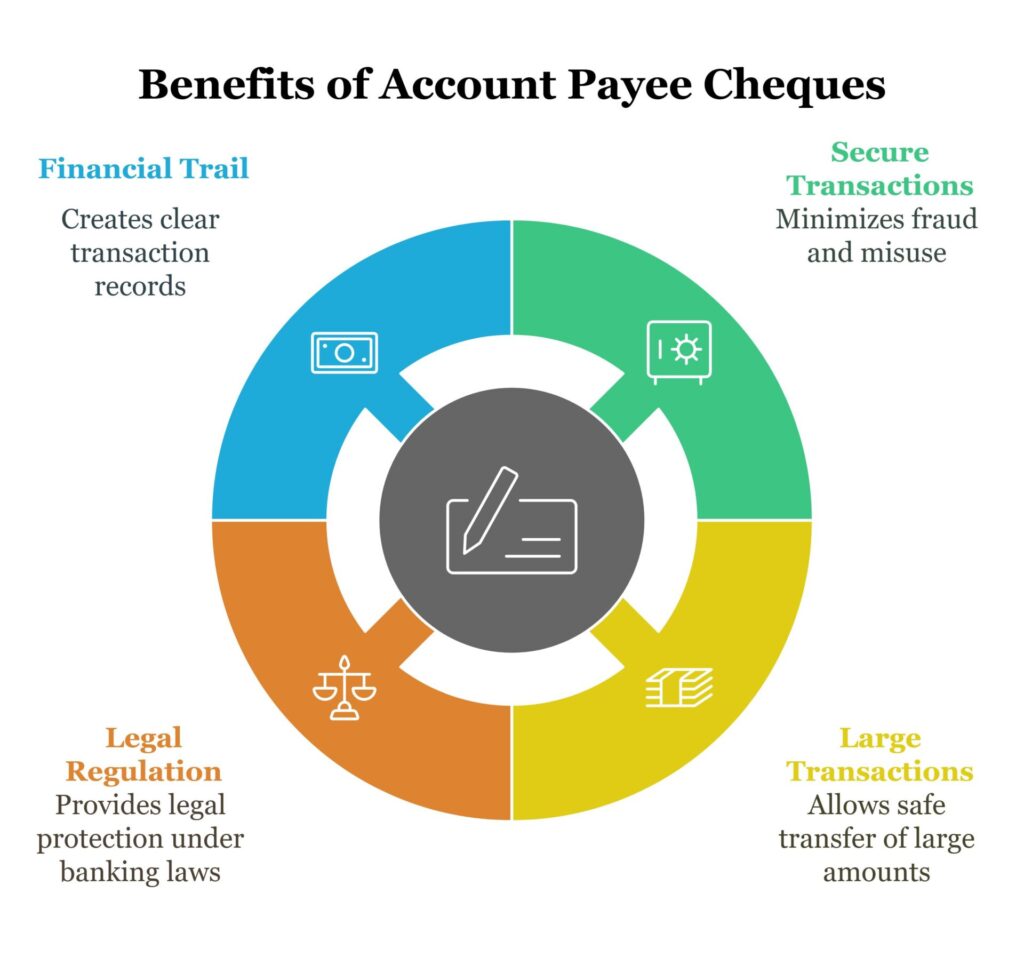
Account payee cheques offer multiple advantages over regular bearer cheques. Here is an overview of some of their key benefits.
- Used for Secure Transactions
Account payee cheques ensure that funds reach the correct recipient safely by drastically minimising the risk of fraud and misuse.
- Useful for Large Transactions
Unlike cash payments, account payee cheques allow you to transfer large amounts without any security concerns.
- Regulated by Banking Laws
In India, account payee cheques are governed by the Negotiable Instruments Act of 1881. The act provides legal protection to the payee in case of disputes or cheque dishonours.
- Financial Trail
Account payee cheques create a clear financial record. Businesses and individuals can track the transactions easily.
Common Mistakes to Avoid When Using Account Payee Cheques
You must be cautious when issuing or handling an account payee cheque since even the smallest of mistakes can lead to it being dishonoured by the bank. Let us look at some of the common mistakes that you need to avoid when dealing with a/c payee cheques.
- Forgetting to mark the top left corner of the cheque leaf with two parallel lines and the words ‘A/C Payee’ is one of the most common mistakes. This will make the cheque into a regular bearer cheque, allowing anyone to encash it over the counter.
- A mismatch between the payee’s name on the cheque and their bank records may lead to cheque rejection. When issuing an account payee cheque, make sure to enter the payee’s name as it appears on their bank records.
- A mismatch between the signature on the cheque leaf and your bank records may also cause the cheque to bounce. When signing the cheque, remember to use the signature registered with your bank to avoid rejection.
- Making manual corrections by overwriting or striking off will render the a/c payee cheque invalid. If you have entered any of the details wrongly, it is better to cancel the cheque and write a new one to avoid such issues.
- Not maintaining an adequate bank balance after issuing an account payee cheque can cause it to bounce. A bounced or dishonoured cheque can lead to penalties, legal consequences or both.
Conclusion
An a/c payee cheque continues to be one of the safest and most reliable methods of making payments. It ensures that the payment reaches the intended recipient securely. If you are issuing such a cheque, ensure that you do not make any of the mistakes mentioned above.
On the other hand, if you are making an account payee cheque deposit, remember to write your name, bank account number and contact information on the back of the leaf. Ensuring accuracy while issuing and handling these cheques can help avoid unnecessary complications.
Related Articles

Cancelled Cheque
Understand the importance of a cancelled cheque, its uses in financial transactions, and how to issue one correctly.

Zero Balance Current Account
Learn about zero balance current accounts, their features, benefits, and how they help businesses manage finances efficiently.
What is a Cheque and Its Types
Know the various types of cheques used in India, their features, and how they function in the banking system.