If you were born or raised in the digital generation in India, you may be extremely familiar with modern methods of payment like instant bank transfers and Unified Payments Interface (UPI) payments. However, before the advent of these payment methods, the cheque was among the most popular ways to transfer money from one account to another.
Despite the evolution of money transfer methods, cheques remain popular among many users today. If you have never used cheques before or if you are not quite familiar with this payment document, it’s always a good idea to learn more about it. In this blog, we take a closer look at what a cheque is, its key features, the different types of cheques, and the pros and cons of this payment method.
What is a Cheque?
A cheque is a document that is issued by a bank. It tells the bank that the amount mentioned in the cheque is payable to the person who presents it or whose name appears on it. This document is considered a negotiable instrument and is covered under the Negotiable Instruments Act of 1881.
The use of cheques eliminates the need for cash transactions. It also makes large-value transactions easier to implement because there is no need to transport large sums of physical currency notes. If you do not know how to write a cheque, it is advisable to learn the process, so you can make the most of this negotiable instrument for money transfers, if needed.
Key Components of a Cheque
Before using this kind of funds transfer, you must understand the format of a cheque. Here are the essential cheque features and key components of this negotiable instrument:
- Date: This field represents the date on which the cheque was issued. You must fill it in using the DD/MM/YYYY format.
- Payee’s Name: The payee is the person to whom you need to make the payment. In the line next to ‘Pay,’ you must fill in the name of this individual or organisation.
- Amount: The format of every cheque includes two fields for the amount; once in words and once in numbers.
- Signature: In this field, the issuer of the cheque must place their signature as mentioned in the official bank records.
- Account Number: This is the number of the issuer’s account with the bank. This is the account from which the funds will be transferred to the payee’s account.
- Cheque Number: This includes the first six numbers written at the bottom of a cheque. It is unique to each cheque.
- Magnetic Ink Character Recognition (MICR) Code: This is the 9-digit string of numbers that follows the cheque number. It helps identify the bank and its branch.
- Transaction Code: The last 2 digits at the bottom of a cheque represent if it is a local cheque (meaning it can only be cashed in at the issuing branch) or if it is payable at par (meaning it can be cashed in at any branch of the issuing bank).
Types of Cheques
Now that you have seen what the format of a cheque includes, let us discuss the different types of cheques you can issue in India. Each kind of cheque serves a specific purpose.
Open Cheque or Bearer Cheque
An open cheque or a bearer cheque is one of the easiest types of cheques to encash. Anybody who is the bearer of the cheque and presents it at an eligible bank branch can cash it over the counter. This kind of cheque can also be transferred from one person to another by mere delivery, making it less secure.
Order Cheque
An order cheque is different from a bearer cheque. To issue this type of cheque, the word ‘bearer’ next to the payee’s name field must be crossed out. This means the payment is to be made to the order of the specified payee, and only they can encash or deposit the cheque in the bank. It ensures that the instrument cannot be easily transferred to another party.
Crossed Cheque
A crossed cheque is one where the issuer adds two diagonal parallel lines — usually on the top left corner. This type of cheque cannot be encashed over the bank counter. It can only be deposited into a bank account. This ensures that the funds are easy to trace and the cheque is not misused by any fraudulent party.
Account Payee Cheque
An account payee cheque is also a type of crossed cheque. However, the crossing in this case is more restrictive because the issuer crosses out the cheque and writes the words ‘Account Payee’ between the lines. This means the cheque can only be deposited into the account of the payee mentioned. It is one of the most secure types of cheques.
Post-Dated Cheque
As the name indicates, this kind of cheque has a future date mentioned on it. This means that the instrument cannot be encashed or deposited before the date mentioned. It is useful for making recurring future payments like rent or loan EMIs.
Stale Cheque
This is a kind of cheque that has been presented at a bank for encashment or deposit after three months from the issue date. Generally, a cheque is valid for three months. After this period, the cheque is no longer valid, and a new one needs to be issued to ensure the transaction can be implemented. The validity period exists to ensure that fraud is minimised.
Truncated Cheque
A truncated cheque makes the transfer and processing faster. Here, instead of physically sending the document from one bank to another, an electronic image of the cheque is used for clearing. This eliminates the need for physical movement and helps save time in the process of encashment.
Traveller’s Cheque
This type of cheque is primarily used by individuals travelling abroad. Instead of carrying cash in bulk, they can use traveller’s cheques, which can be encashed in a foreign currency abroad. These cheques are generally prepaid and may not have any fixed expiry, so they can be used during future travels.
Banker’s Cheque / Pay Order
As the name indicates, this kind of cheque is issued by the bank itself on behalf of a customer. This means such cheques are backed by the issuing bank’s guarantee. They are best suited for large-value payments that require a higher degree of security, such as paying for a property or paying a government fee. Since the instrument is drawn on the bank’s funds, the risk of default is eliminated.
Cheque and Types of Cheque: A Quick Reference Table
| Type of Cheque | Primary Feature | Security Level | Common Use Case |
| Bearer Cheque | Payable to the person holding it | Low | Cash withdrawal over the counter |
| Order Cheque | Payable only to the named person | Medium | General payments |
| Crossed Cheque | Can only be deposited, not cashed | High | Ensuring funds go to an account |
| Account Payee Cheque | Can only be credited to the named payee’s account | Highest | High-value, secure payments |
| Post-Dated Cheque | Valid only on or after a future date | Medium | EMIs, rent, future commitments |
| Banker’s Cheque | Issued and guaranteed by the bank | Very High | Government payments, large fees |
How to Fill a Cheque Correctly?
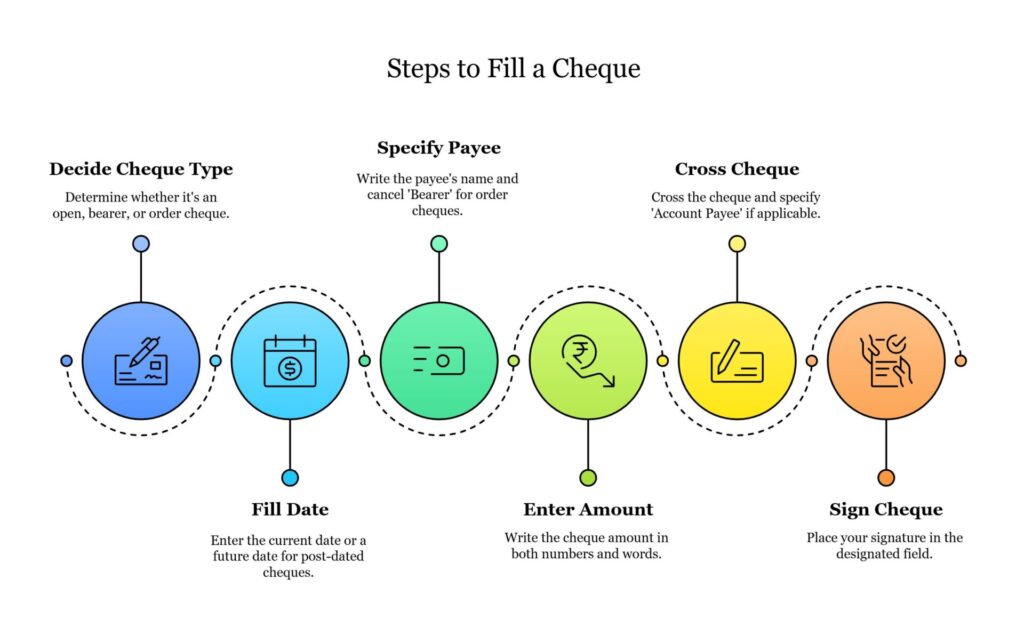
Filling in a cheque is fairly easy if you are familiar with the format of a cheque. Here is a step-by-step guide to how you can correctly fill out any type of cheque.
- Step 1: Begin by deciding what type of cheque you want to issue.
- Step 2: Fill in the date as needed. It could be the date of issue or a future date if you want to issue a post-dated cheque.
- Step 3: If you want to issue an open or bearer cheque, you can simply tick the word ‘Bearer’ mentioned on the document. However, if you want to issue an order cheque, you must write the name of the payee on the cheque and cancel out the word ‘Bearer.’
- Step 4: Then, enter the amount to be paid in numbers and words.
- Step 5: Cross the cheque if needed. In case you are issuing an account payee cheque, ensure you write the words ‘Account Payee’ between the lines used for crossing.
- Step 6: Place your signature in the appropriate field.
This completes the process of writing a cheque correctly. Your cheque is then ready to be encashed.
Advantages and Disadvantages of Using Cheques
Using cheques drawn on your bank account can be beneficial in many ways. However, this method of payment also has certain limitations. Let us explore both sides of this negotiable instrument.
Advantages of Using Cheques
- Secure Transactions: A cheque payment is typically secure. Even if a cheque is lost or stolen, you can contact your bank to stop the payment and ensure that the funds are not transferred to the wrong party.
- Easy Tracking of Funds: With cheques, it is easy to maintain comprehensive records of various payments. It is also easy to track the movement of funds from one account to another.
- Cost-Effective Mode of Fund Transfer: When you transfer money from one account to another using cheques, you need not pay any additional charges. This makes cheques a highly cost-effective mode of transferring money or making payments.
- Widely Accepted: Cheque payments are still popular, and these negotiable instruments are widely accepted across India. Given that they offer the option to encash the funds, cheques are suitable for all kinds of users.
- Suitable for High-Value Transfers: There is no minimum or maximum limit on the amount that can be transferred using cheques. This makes them suitable for both regular and high-value transactions.
Disadvantages of Using Cheques
- Risk of Bouncing: If the issuer of the cheque does not have sufficient funds in their bank account, the cheque may bounce, and the transaction cannot be completed.
- Longer Processing Time: It may take a few hours to a few business days for cheques to be processed. This can be inconvenient for emergency transactions.
- Limited Usage: With modern fund transfer methods like NEFT, RTGS and IMPS now available, the usage of cheques has diminished.
The Cheque Clearance Process
In India, the cheque clearance process is implemented using a standard protocol called the Cheque Truncation System (CTS). When you draw a cheque on your savings account or current account, and it is deposited in a bank, the bank scans the cheque and sends its image to the clearinghouse.
The clearinghouse then verifies the details and forwards them to the issuing bank for validation. This method of using an image or an e-cheque eliminates the need for the physical movement of these negotiable instruments. As a result, the process becomes faster and more secure.
The issuing bank then checks if you have sufficient funds in your bank account. Your signature is also verified to ensure authenticity. Furthermore, the bank checks for any potential errors or discrepancies that may make the cheque invalid. If no issues are found, the cheque is approved, and the amount is transferred from your account to the depositor’s or payee’s account. However, if the cheque is rejected, it will be returned to you with the appropriate reasons mentioned.
Also Read- Difference between RTGS, NEFT and IMPS
Digital Alternatives to Cheques
The different kinds of cheques discussed in this article can be useful in various situations. However, with the evolution of digital banking solutions, it has now become possible to transfer funds using more convenient digital alternatives, such as:
- National Electronic Funds Transfer (NEFT): This system allows bank customers to transfer funds between accounts. Fund transfers occur in batches and are completed within a few hours, at most.
- Real-Time Gross Settlement (RTGS): RTGS allows for real-time transfers of high-value sums. Here, transactions are processed and settled individually.
- Immediate Payment Service (IMPS): This service supports the transfer of funds from one bank account to another using mobile numbers, account details and MMIDs.
- Unified Payments Interface (UPI): The UPI system facilitates seamless transfers and payments via mobile apps using QR codes, UPI IDs or mobile numbers.
- Credit Cards: With credit cards, users can make cashless payments for purchases and rely on the option to repay the sum later or convert the transactions into EMIs.
- Debit Cards: With debit cards, users can directly pay for goods and services. The money is deducted from the bank account linked to the debit card.
- Mobile Wallets: Users can recharge mobile wallets using UPI or other payment modes. The amount is then stored digitally and can be used to make payments.
Conclusion
While modern electronic methods of fund transfers are popular today, cheques continue to remain widely used due to their security features and suitability for high-value transactions. This is why learning what a cheque is and what the different types of cheques are is an essential part of your journey towards practical financial literacy. Now that you know these important aspects of bank cheques, you can easily issue or encash one as needed.
Frequently Asked Questions
1. What is a cheque and how does it work?
A cheque is a written order directing a bank to pay a specific amount from the issuer’s account to the person named on the cheque. It acts as a negotiable instrument governed by the Negotiable Instruments Act, 1881. Once issued, it can be deposited or encashed by the payee at a bank.
2. What are the different types of cheques in India?
Common types include bearer cheques, order cheques, crossed cheques, account payee cheques, post-dated cheques, truncated cheques, and banker’s cheques. Each serves a specific purpose, offering varying levels of security and transferability. The type chosen depends on how and to whom the funds are to be paid.
3. How do I fill out a cheque correctly?
Start by writing the date and the payee’s name, then enter the amount in both numbers and words. Add any necessary markings (like crossing lines for account payee cheques), and sign the cheque as per bank records. Double-check all details to avoid rejection or misuse.
4. What are the advantages and disadvantages of using cheques?
Cheques offer secure, traceable, and cost-effective payments, especially useful for high-value transfers. However, they can bounce if funds are insufficient and take longer to process compared to digital methods. Their usage has declined with the rise of instant digital payment systems.
5. How are cheques cleared in India today?
Cheques are cleared through the Cheque Truncation System (CTS), where banks send scanned images to a central clearinghouse. The issuing bank verifies funds, signatures, and details before approving the transaction. This system speeds up processing and reduces the need for physical cheque movement.
1. What is a cheque and how does it work?
2. What are the different types of cheques in India?
3. How do I fill out a cheque correctly?
4. What are the advantages and disadvantages of using cheques?
5. How are cheques cleared in India today?
Related Articles
The Different Types of Collateral You Can Use for Business Loans
Understand which assets can be pledged as collateral when applying for business loans and how they impact approval.
Dishonoured Cheques: Meaning, Causes & Legal Implications
Learn what leads to cheque dishonour, legal consequences, and how to prevent such financial setbacks in your business.

What is a Cancelled Cheque? Uses, Format & Precautions
Know why cancelled cheques are needed in banking and loan processes, and how to issue them correctly.