Micro, Small, and Medium Enterprises (MSMEs) drive India’s economic growth, contributing around 30% to the country’s GDP. These businesses, from small shops to manufacturing units, fuel entrepreneurship development and job creation. Understanding MSMEs is essential to support their growth and impact.
Classification of MSME
MSMEs in India encompass a wide range of businesses that produce goods, provide services, or engage in trading activities. These enterprises are classified based on their investment in plant and machinery or equipment and their annual turnover. The MSME classification helps in tailoring government policies and support mechanisms to suit the needs of different types of businesses.
| Micro Enterprises | Small Enterprises | Medium Enterprises | |
| Nature-Based | Micro enterprises are the smallest units in the MSME sector, often operating at a grassroots level. These businesses typically have a minimal workforce and require low capital investment. | Small enterprises represent a step up from micro-businesses, with a larger scale of operations and workforce. | Medium enterprises bridge the gap between small businesses and large corporations. They have a more substantial workforce and higher annual turnover. |
| Investment-Based | Up to ₹1 crore | Up to ₹10 crores | Up to ₹50 crores |
| Turnover-Based | Less than ₹5 crores | Less than ₹50 crores | Less than ₹250 crores |
These thresholds reflect the scale of operations and help in determining eligibility for various government schemes and benefits tailored to each category.
What are Micro, Small, and Medium Enterprises?
1. Micro Enterprises:
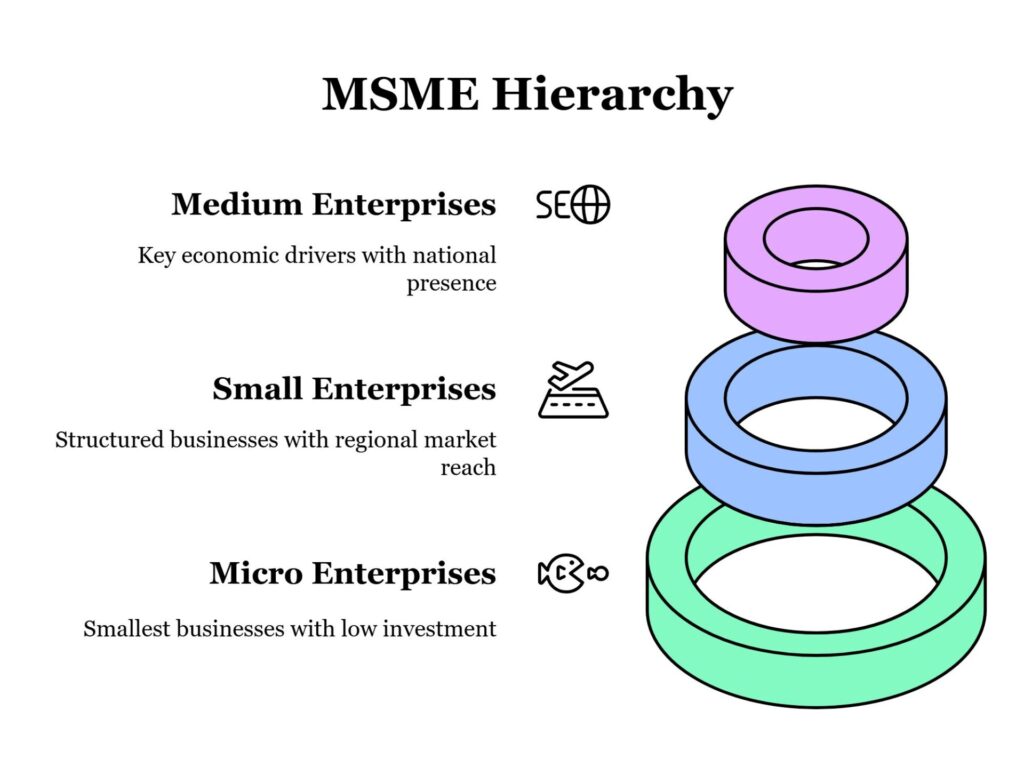
Smallest in the MSME business, micro-enterprises operate with low investment and under 10 employees. They form over 90% of registered businesses, offering essential local goods and services. Examples include street vendors, carpentry and bakery shops.
Features of Micro Enterprises
- Low Entry Barriers: Micro enterprises require minimal business investment, making entrepreneurship development accessible to many.
- Simple Structure: Typically owner-managed, ensuring flexibility and quick decisions.
- Local Focus: These enterprises serve neighbourhood markets, strengthening community ties.
- Flexible Operations: Micro businesses quickly adapt to changing market needs.
- Diverse Sectors: They are found in areas from traditional crafts to modern services.
Benefits of Micro Enterprises
- Job Creation: Micro enterprises generate employment, especially in areas with fewer formal job opportunities.
- Local Economic Growth: They circulate money within communities, promoting grassroots-level wealth distribution.
- Skill Development: These businesses train workers in small business management and entrepreneurial skills.
- Innovation at Ground Level: Limited resources drive creative solutions for local needs.
- Social Cohesion: They strengthen community ties by providing spaces for local interaction and support.
2. Small Enterprises:
Small enterprises are businesses with 10 to 50 people and have a structured organisation. They are often run by individuals or small teams. MSME examples for small enterprises include stationery shops, candle shops and bookstores.
Features of Small Enterprises
- Increased Complexity: Small enterprises have defined roles which improve efficiency and productivity,
- Wider Market Reach: They serve regional or national customers, diversifying revenue.
- Greater Access to Resources: These enterprises get more funding, enabling better technology and equipment investment.
- Enhanced Product and Service Offerings: They provide diverse offerings, reducing small business risk.
- Potential for Scalability: Structured for growth, making them attractive for business investment.
Benefits of Small Enterprises
- Job Creation: employment with better pay and benefits.
- Market Efficiency: Competition with larger firms improves productivity and economic growth.
- Innovation: R&D investments lead to innovative products and services.
- Skill Development: Small enterprises often provide training programs which enhance workforce quality.
- Regional Development: Economic hubs in smaller towns reduce urban migration.
3. Medium Enterprises:
Medium enterprises are the largest category within the MSME business, employing 50 to 250 workers. They operate with substantial investments and turnover, making a key economic driver. Their presence in sectors like manufacturing, wholesale and technology significantly impacts industrial growth.
Features of Medium Enterprises
- Formalized Organization: Medium enterprises have structured management with specialised departments, ensuring efficient operations and strategy decision-making.
- Wider Market Reach: They operate at a national level and engage in exports, reducing reliance on local markets and enhancing global trade opportunities.
- Proper Infrastructure: These businesses invest in advanced technology and facilities, improving productivity and maintaining consistent quality in operations.
- Potential for Further Growth: With strong financial backing, medium enterprises can scale into large corporations, attracting business loan government schemes and private investors for long-term expansion.
- Diversification: Many medium enterprises expand their products or service range, reducing market risks and capitalising on multiple revenue streams.
Benefits of Medium Enterprises
- High-Quality Employment: Medium enterprises often create skilled, well-paying jobs, fostering a professional workforce and improving living standards.
- Export Contribution: By engaging in exports, they contribute to foreign exchange earnings, strengthening India’s global economic position.
- Technology Transfer: These enterprises adopt and distribute advanced technologies. They enhance overall industry efficiency and competitiveness.
- Supply Chain Integration: Medium enterprises play a crucial role in supply chains, supporting large corporations and boosting industrial productivity.
- Corporate Social Responsibility: Many medium enterprises engage in CSR activities and invest in entrepreneurship development, driving sustainable growth and addressing social challenges.
Importance of Micro, Small, and Medium Enterprises to India
Micro, Small, and Medium Enterprises (MSMEs) are a cornerstone of India’s economy. It plays a critical role in driving growth, creating jobs, and fostering social development. These MSME enterprises contribute significantly to India’s economic framework through various channels:
- Economic Contribution: MSMEs account for nearly 30% of India’s GDP. They add value across sectors and promote balanced economic growth.
- Employment Generation: They create millions of jobs, especially in rural and underserved areas, reducing unemployment and driving financial security.
- Promotion of Exports: MSMEs contribute almost half of India’s total exports, enhancing trade diversity and increasing foreign exchange earnings.
- Industrialization of Rural Areas: By utilising local resources and talent, MSMEs boost rural economics and reduce migration to urban centres.
- Inclusive Growth: These businesses empower women and marginalised communities, with schemes like MSME loan for women supporting their entrepreneurial journey.
- Nurturing Innovation: MSMEs quickly adapt to market needs, developing cost-effective solutions that drive economic and technological progress.
- Regional Development: Their presence in semi-urban and rural areas ensures decentralised industrial growth, bridging economic disparities across regions.
- Financial Assistance: Entrepreneurs can access MSME business loans, startup loans and small business loan government programs to fund expansion and innovation.
- Encouraging Startups: Government initiatives support start up businesses by providing MSME loan eligibility for new business to ensure long-term success.
- Strengthening Capital: Various funding programs, including funds for small business and small business capital help MSMEs sustain operations and scale efficiently.
- Ease of Business: Government policies simplify the steps to start a small business, making it easier for new entrepreneurs to invest in small businesses and thrive.
Difference Between MSME and SME
The terms SMEs and MSMEs are often used interchangeably, but there is a subtle difference. While Small and Medium Enterprises (SMEs) have been a commonly used term, MSME is the more comprehensive and officially recognized terminology. The inclusion of “Micro” in MSME reflects the government’s recognition of the smallest enterprises that form a significant part of India’s informal economy.
The shift towards using MSME instead of SME aligns with the government’s focus on supporting and developing the entire spectrum of small businesses. It includes street vendors and medium-sized manufacturers. This inclusive approach ensures that even the smallest entrepreneurs are acknowledged and supported in policy frameworks.
Role of Micro, Small and Medium Enterprises Ministry
- Government Initiatives: The government has implemented various initiatives to nurture and support the MSME sector by recognizing its crucial role in India. These efforts are designed to address the unique challenges faced by MSMEs and create an enabling environment for their growth.
- Policy Formulation and Implementation: The Ministry of Micro, Small, and Medium Enterprises takes a proactive approach to crafting policies that foster MSME growth. These policies encompass a range of support mechanisms, including:
- Financial incentives such as subsidies on loans and reduced interest rates
- Tax benefits to encourage formalization and growth
- Simplification of compliance procedures to ease regulatory burden
- Preferential procurement policies in government contracts
The ministry also focuses on effective communication of these policies, ensuring that even small entrepreneurs in remote areas are aware of and can access these benefits.
- Promotion of MSMEs: To boost the MSME sector, the government has launched various schemes and programs aimed at enhancing skills, and fostering innovation. and facilitating business development. These initiatives create a supportive ecosystem for entrepreneurs at every stage of the journey. One such program is the Entrepreneurship and Skill Development Programme (ESDP).
The ESDP is a comprehensive initiative designed to nurture entrepreneurial talent and equip individuals with the skills needed to establish and run successful MSMEs. This program encompasses a range of activities:
- Entrepreneurship Awareness Programme: This program introduces the concept of entrepreneurship and self-employment as viable career options.
- Industrial Motivational Campaign: This campaign inspires potential entrepreneurs through success stories and expert interactions.
- Management Development Programme: This equips existing MSME owners with modern management techniques to scale their businesses.
- Entrepreneurship-cum Skill Development Programme: This provides hands-on training on specific trades or industries to create job-ready individuals.
These programs impart knowledge as well as help build a network of like-minded individuals. It fosters a culture of entrepreneurship across the country.
- Financial Assistance: Access to finance remains a critical challenge for many MSMEs. To address this, the government has taken several steps:
- Coordinating with financial institutions to streamline loan processes for MSMEs
- Implementing credit guarantee schemes to encourage banks to lend to MSMEs without collateral
- Setting up dedicated MSME banks and microfinance institutions
- Infrastructure Development: The development of infrastructure tailored to MSME needs is a key focus area. This includes:
- Establishing industrial parks with modern facilities at subsidized rates
- Creating common facility centers where MSMEs can access advanced machinery and technology
- Developing logistics hubs to improve supply chain efficiency for small businesses
- Facilitating Innovation and Technology Upgrade: In an increasingly digital world, technological competitiveness is crucial for MSME success. The government’s initiatives in this area include:
- Supporting design improvement to enhance product quality and marketability
- Promoting lean manufacturing techniques to reduce waste and improve efficiency
- Building awareness about Intellectual Property Rights to protect innovations
- Encouraging digital empowerment through e-commerce platforms and digital payment systems
These measures aim to equip MSMEs with the tools and knowledge needed to compete in both domestic and global markets. It drives innovation and growth in the sector.
Challenges Faced by MSMEs
- Financial Constants: Securing funds remains a major hurdle for the MSME business sector. Many small businesses struggle with loan eligibility due to a lack of collateral and credit history.
- Limited Government Support: Despite business loan government initiatives, many MSMEs lack awareness of various schemes, restricting access to essential funds for small businesses.
- Skill Deficient: A largely informal workforce hampers productivity. Without proper entrepreneurship development, businesses struggle to scale.
- Technological Gap: High business investment costs prevent modernisation. Limited access to new machinery and digital tools puts MSMEs at a disadvantage.
- Operational Difficulties: Supply chain disruptions, regulatory compliance and weak marketing strategies impact growth.
- Management Challenges: Lack of structured small business management leads to inefficiencies. Many entrepreneurs lack guidance on the steps to start a small business, affecting sustainability.
Boost Your Business with MSME Loans from Lendingkart
Lendingkart offers tailored financial solutions for MSMEs in India, understanding the unique needs of small businesses. Our loan offerings have several advantages:
- Collateral-Free Loans: Lendingkart provides loans without requiring collateral, making it easier for small businesses to access funds.
- Flexible Use: Loans can be used for various purposes, from purchasing inventory to expanding operations or investing in marketing.
- Quick Processing: With a streamlined application process, businesses can receive funds quickly, often within a few days of approval.
- Competitive Interest Rates: Lendingkart offers competitive rates, helping businesses manage their finances effectively.
- Minimal Documentation: The loan application process requires minimal paperwork, reducing the hassle for busy entrepreneurs.
Conclusion
MSMEs are a vital aspect of the Indian economic landscape, driving growth, innovation, and employment. From micro to medium enterprises, each contributes to the country’s economy. With support from financial institutions like Lendingkart, these enterprises are well-positioned to continue their crucial role in shaping India’s economic future.
Frequently Asked Questions
1. What is the difference between Micro, Small, and Medium Enterprises in India?
* Micro Enterprises: Investment up to ₹1 crore and turnover under ₹5 crores.
* Small Enterprises: Investment up to ₹10 crores and turnover under ₹50 crores.
* Medium Enterprises: Investment up to ₹50 crores and turnover under ₹250 crores. This classification helps tailor policies and financial support based on business size and needs.
2. Why are MSMEs important to the Indian economy?
* Around 30% to India’s GDP
* Nearly half of India’s exports
* Massive job creation, especially in rural and semi-urban areas. They also promote inclusive growth, innovation, and entrepreneurship, and help industrialize underdeveloped regions.
3. How does the government support MSMEs?
* Loan subsidies and credit guarantees
* Skill development and training programs (like ESDP)
* Infrastructure development through industrial parks
* Technology upgrades and digital empowerment
* Simplified compliance and tax incentives Initiatives like Udyam Registration, CGTMSE, and Startup India are also designed to empower MSMEs.
4. What challenges do MSMEs commonly face in India?
* Limited access to finance, especially collateral-free funding
* Lack of awareness of government schemes
* Technological lag due to high costs
* Unskilled workforce and lack of structured training
* Weak marketing and compliance capabilities Addressing these issues is crucial to ensure MSME sustainability and growth.
5. How can MSMEs benefit from Lendingkart’s business loans?
* Collateral-free loans with fast disbursal
* Minimal documentation and fully digital application process
* Flexible usage of funds (for inventory, marketing, or expansion)
* Competitive interest rates These features make Lendingkart an ideal choice for MSMEs seeking quick and efficient financing.
Related Articles
Impact of Micro Loans on Small Business Growth
Understand how micro loans help small businesses scale by offering accessible credit and empowering grassroots entrepreneurship.

What is Micro Lending?
Learn the fundamentals of micro lending, its purpose, and how it supports financially underserved business owners.

Understanding Micro Loans for Women
Explore how micro loans tailored for women are transforming lives and enabling female-led startups across India.