

From your monthly salary and rent to sending money home or paying for goods and services, every financial transaction involves the transfer of money between banks. Today, with the evolution of digital banking systems, it is possible to complete bank-to-bank transfers quickly and in a hassle-free manner.
The turning point in electronic fund transfers occurred in November 2005, when NEFT was introduced to facilitate fund transfers from one bank to another at minimal costs. We now also have other channels, like IMPS and RTGS. However, many users of the banking system in India find themselves confused about the NEFT settlement time.
If you are also unaware of these details, you can find the answers to all your questions about NEFT transfer times in this article. Check out the meaning of NEFT, the details of the NEFT money transfer time, the old and new guidelines for NEFT and more.
What is NEFT?
NEFT, or National Electronic Fund Transfer, is a method of sending money from one bank account to another electronically. Since the channel is regulated by the Reserve Bank of India (RBI), it is one of the most secure ways to transfer money between bank accounts.
You can use NEFT to send money to the beneficiary’s account online or offline. All you need to effect this kind of electronic money transfer are the beneficiary’s name, bank account number, IFSC and contact details. The upside of choosing the National Electronic Fund Transfer option is that you can send money at zero cost (or, in some cases, at nominal costs).
How Much Time Does it Take to Settle NEFT Transactions?
Transfers made via NEFT are settled in batches at intervals of 30 minutes. So, in most cases, the NEFT money transfer time is around 30 minutes to around one hour. However, this may not always be the case.
If you are sending money to a newly added beneficiary account, the NEFT processing time may go up to two hours. This is because the central bank needs to verify the details of the newly added beneficiary, and that process can take around 30 minutes or so.
NEFT Transfer Timings (Old vs New Guidelines)
Now that we have seen what the NEFT processing time is for different batches of transactions let us delve into the NEFT transfer times. Can you initiate an NEFT transaction at any time during the day, or is there a specific window of time when this facility is available?
Till December 2019, NEFT money transfer times were restricted. Transfers could only be processed from 8 AM to 6.30 PM on weekdays and from 8 AM to 12 noon on Saturdays. In addition to this, NEFT payments were also not supported on banking holidays.
However, these rules have been amended, and NEFT can now be used to send money electronically at any time during the day or night and on any day of the week. This has eased the process of transferring money from one bank account to another and made it possible to send and receive funds within an hour or two at most.
Beneficiary Details Required for Remitting Funds through NEFT
While NEFT payment time windows may be 24/7, you need to ensure that you submit the correct beneficiary details when you are sending money. This will help you avoid sending the funds to the wrong account by accident. Here are the details you need to remit funds through the National Electronic Fund Transfer channel.
- Beneficiary’s Name: Ensure that you enter the beneficiary’s name correctly, without any errors in spelling. It must match the name in the bank records.
- Name of the Beneficiary’s Bank: This is the name of the bank in which the beneficiary holds an account.
- Name of the Beneficiary’s Bank Branch: This is the name of the branch in which the account is held. Ensure that you use the official branch name.
- Beneficiary’s Account Number: This is the account number of the beneficiary. It is typically a set of numbers. The length depends on the bank. Make sure there is no error in the account number you are using.
- Type of Account: You must also submit the details of the type of account — whether current or savings.
- IFSC: The IFSC or the Indian Financial System Code is a 11-digit code with alphabets and numbers. It is unique to each bank branch and is required to confirm the NEFT money transfer.
How Secure is NEFT?
Many people, particularly from the older generations, may not be quite comfortable with electronic fund transfers. This is primarily because of concerns regarding data and financial security.
However, if you want to transfer funds using the National Electronic Fund Transfer channel, you need not worry about security. This is because the Reserve Bank of India oversees NEFT transactions and has stringent security measures in place, such as the following:
- Authentication: To ensure that the sender and the receiver are both legitimate, the NEFT channel relies on digital signatures. This helps authenticate the parties involved in the NEFT transaction.
- Data Encryption: Advanced encryption solutions are used to ensure that no party can access the data of NEFT users without prior authorisation. This adds to the existing security protocols.
- Verification: Checksums are used to detect any errors in the data transmitted. In addition to this, hash values are used to verify the integrity of the information transmitted for each NEFT transaction.
- Transaction Reconciliation: Audit trails add to the above-mentioned security measures. They track the details of each transaction and verify them to ensure the right parties are held accountable.
Why is NEFT the Most Preferred Mode of Fund Transfer?
While other fund transfer methods like RTGS and IMPS are also extremely popular, NEFT offers several benefits for users in the banking system. The key advantages that make National Electronic Fund Transfers so popular include the following:
- No Transaction Limit: The central bank has not specified any particular limit on the maximum amount for NEFT. That said, some banks may have their own NEFT limits in place.
- Quick Settlements: The NEFT settlement time is quite short, with batches being processed every half hour. This makes it a preferred choice for people who wish to send money quickly.
- 24/7 Availability: With the new changes in the NEFT money transfer time, it is now possible to initiate NEFT transactions at any time and on any day of the week, including bank holidays.
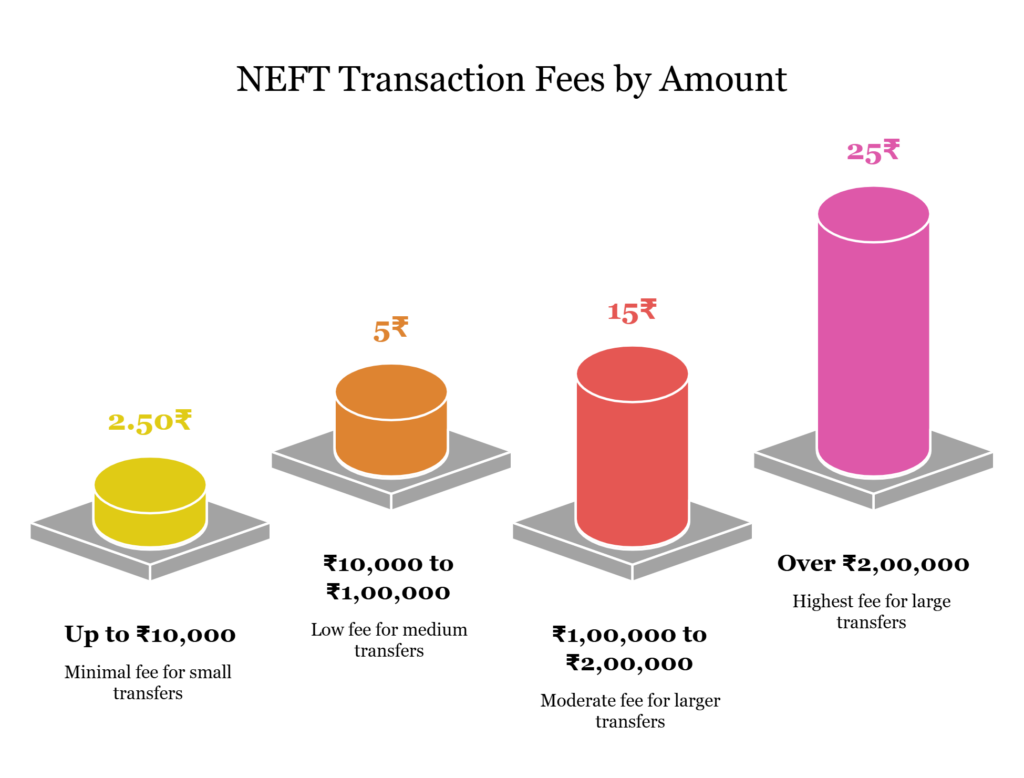
- Zero or Nominal Charges: Many banks offer NEFT transfer facilities free of cost. Others may levy a nominal fee. The RBI has also set limits on the maximum NEFT fees that banks can charge per NEFT transaction based on the transaction value. These limits are as follows:
- For transfers up to ₹10,000: Fee up to ₹2.50 + GST
- For transfers from ₹10,000 to ₹1,00,000: Fee up to ₹5 + GST
- For transfers from ₹1,00,000 to ₹2,00,000: Fee up to ₹15 + GST
- For transfers over ₹2,00,000: Fee up to ₹25 + GST
Conclusion
The National Electronic Fund Transfer system can be extremely useful for anyone who wants to transfer funds without paying a hefty charge. With all leading banks in India now offering internet banking facilities, NEFT is now more accessible than ever before. The RBI’s security measures ensure that these bank transfers are safe and invulnerable to easy fraud.
Related Articles
NEFT Timings 2025
Check the updated NEFT transfer timings, operational hours, and holiday schedule for 2025 to ensure timely fund transfers.

NEFT vs RTGS vs IMPS
Understand the key differences between NEFT, RTGS, and IMPS to choose the right fund transfer method based on your needs.

Working Capital Requirement
Learn how to calculate your business’s working capital requirement to maintain smooth operations and ensure financial health.