

The indirect tax regime was completely overhauled in 2017 with the introduction of the Goods and Services Tax (GST). The implementation of GST is a changing moment in India’s fiscal history, transforming a fragmented tax landscape with over 17 different indirect taxes into a streamlined, technology-driven system that promotes ease of doing business.
Now, one of the key components of GST in India is the Integrated Goods and Services Tax (IGST). Understanding this particular component is crucial if you are a supplier of goods and services frequently involved in inter-state trade, imports or exports.
In this article, we will delve into the concept of IGST and its implications in detail. Additionally, we will also look at some of its key features, benefits and the IGST refund process.
What is IGST?
The full form of IGST is Integrated Goods and Services Tax. It is a part of the GST framework. It was implemented primarily to facilitate the collection of GST on goods and services supplied from one state to another (interstate). However, it also applies to imports and exports of goods and services.
The key objective of the Integrated Goods and Services Tax is to simplify the taxation process for interstate trade and commerce. Before the implementation of IGST, interstate suppliers of goods and services had to deal with multiple taxes ranging from Central Sales Tax (CST) and entry tax to octroi and service tax. IGST, however, eliminated multiple taxes by providing a single, unified tax structure. This consolidation has been particularly beneficial for e-commerce businesses, logistics companies, and manufacturers with pan-India operations.
What are the Characteristics of GST?
Before diving deeper into IGST specifics, it’s important to understand the broader characteristics of GST that make the Indian indirect tax system unique:
Multi-Stage Tax Collection
GST is levied at every stage of the supply chain, from manufacturer to wholesaler to retailer. This prevents tax pyramiding and ensures that the final consumer bears only the GST charged by the last dealer in the supply chain.
Destination-Based Taxation
One of the fundamental characteristics of GST is that it follows a destination-based principle, meaning tax revenue accrues to the state where consumption occurs, not where production happens.
Input Tax Credit Mechanism
Another characteristic of GST is the seamless flow of input tax credit across the value chain and across state boundaries. Businesses can offset GST paid on inputs against GST liability on outputs, significantly reducing the effective tax burden.
Technology-Driven Compliance
GST operates on a digital infrastructure, which enables online registration, return filing, payment, and refund processing. This digitisation has improved transparency and reduced human interface with tax authorities.
Uniform Tax Rates
GST leads to the standardisation of tax rates across India, eliminating the varying state-level taxes that previously existed. Goods and services are categorised into tax slabs of 0%, 12%, 18%, and 28%, ensuring predictability for businesses.
Components of GST
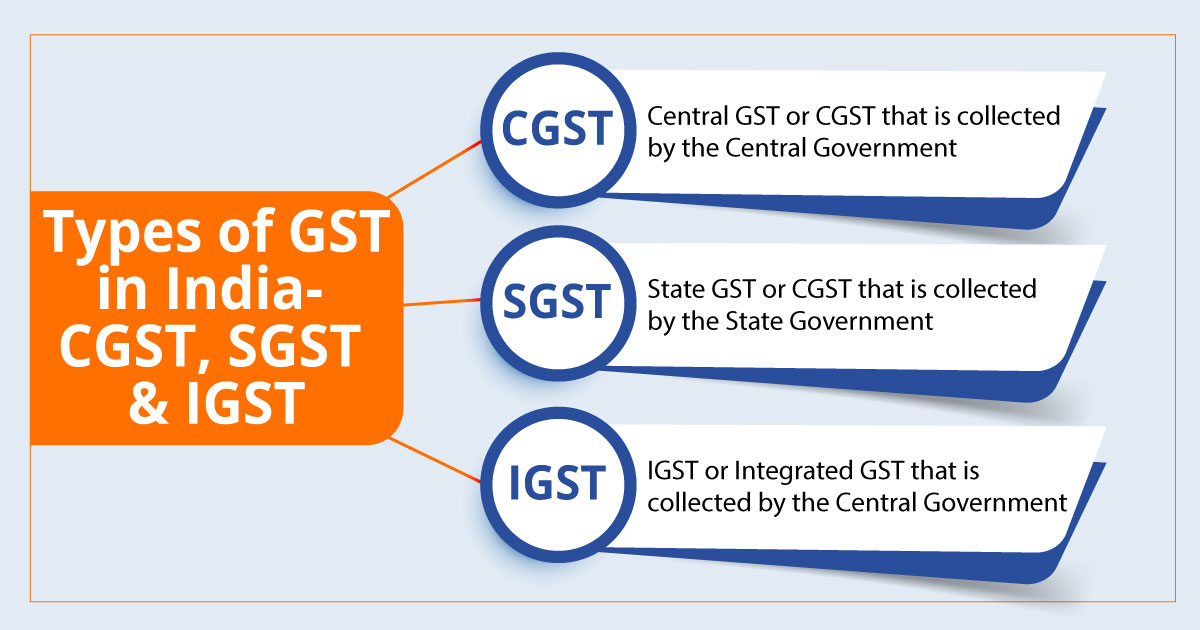
The indirect taxation framework of GST can be divided into three major components: SGST, CGST and IGST. Here is a quick overview of each of these components in detail.
- SGST (State Goods and Services Tax)
The State Goods and Services Tax (SGST) is imposed on the goods and services supplied within the same state. The SGST is collected by the government of the state in which the supply took place and is used for infrastructure development and funding public services and welfare schemes. The rate of applicable SGST varies depending on the goods and services in question.
- CGST (Central Goods and Services Tax)
The Central Goods and Services Tax (CGST) is also imposed on the goods and services supplied within the same state. The CGST is collected by the central government on intrastate supplies and is used for funding national-level projects and services. The rate of CGST also varies depending on the goods and services in question.
The CGST and SGST rates on goods and services have been kept equal to maintain a sense of balance and fairness between central and state tax authorities. For example, in the case of sugar, the applicable GST rate is 5%, of which 2.5% goes towards CGST and 2.5% towards SGST.
- IGST (Integrated Goods and Services Tax)
As you have already seen, the Integrated Goods and Services Tax is only imposed on interstate transactions, where the supply of goods or services is from one state to another.
Now, it is important to note that IGST is collected by the central government. The collected tax revenue is then appropriately distributed to the respective destination state governments after reconciliation. The Integrated Goods and Services Tax prevents complications often associated with interstate trade by promoting a standardised tax structure across the country.
Applicability of IGST
According to the GST regulations, Integrated Goods and Services Tax is only applicable in the following two scenarios.
- Inter-State Supply of Goods and Services
If you sell goods or provide services from one state to another, IGST is levied instead of CGST and SGST. IGST ensures uniform taxation across the country without complications.
For example, assume you are a supplier of footwear based out of Maharashtra. If you sell your products to a customer in another state, say, Uttar Pradesh, the Integrated Goods and Services Tax will be applicable.
- Imports and Exports
If you import goods into India from another country, you will be liable to pay the Integrated Goods and Services Tax. By levying IGST on imported goods, the framework ensures uniform taxation across borders.
For instance, assume you are a supplier of fabric based out of Tamil Nadu. You import a certain fabric from China to resell it in India. In this case, IGST will be levied on the value of the fabric you imported from China.
As per GST rules, Integrated Goods and Services Tax is also applicable to the export of goods and services. However, the tax rate is 0%, meaning that there is no tax liability. However, on such a zero-rated supply of goods and services, you can claim an input tax credit (ITC) on the GST paid on the inputs to reduce your overall liability.
For example, let us say that you export stitched apparel from India to other countries. The tax rate on such exports is 0%. However, the GST you paid for the raw materials used in the production of the stitched apparel can be claimed as an input tax credit to reduce your overall tax liability.
IGST Calculation and Example
Calculating the IGST liability on the interstate supply of goods and services is easy and straightforward. All you need to do is use the following mathematical formula to calculate IGST liability. The formula to calculate IGST is:
IGST = Value of the Transaction × IGST Rate
Now, let us look at a hypothetical IGST example to understand how tax liability is actually calculated. Let us assume that you are a retailer selling computers and printers based in Karnataka. The IGST rate on computers and printers is 18%.
You sell products worth ₹50,000 to a customer in Madhya Pradesh. The total Integrated Goods and Services Tax liability on this transaction can be quickly computed by using the above-mentioned GST formula.
IGST = ₹50,000 x 18%
IGST = ₹9,000
Now, when you raise an invoice to your customer in Madhya Pradesh, the total value of the transaction will be ₹59,000 (₹50,000 + ₹9000 IGST amount).
What are the Features of IGST?
The Integrated Goods and Services Tax has certain unique features that set it apart from the other components of the GST framework. Let us explore a few of the key features of IGST.
- Uniform Taxation
In the case of an intrastate supply of goods or services, both CGST and SGST are levied. As you have already seen, CGST is collected by the central government and SGST is collected by the respective state government. Such an arrangement can be highly confusing, especially for small businesses that often lack an in-depth understanding of the indirect taxation framework.
With IGST, however, there is no such confusion since there is a consistent and uniform tax rate across all states. By having a single rate, the taxing authority aims to prevent discrepancies and make compliance easier for businesses operating in multiple states.
- Input Tax Credit (ITC)
Under the IGST Act, the input GST can be claimed as a deduction to reduce your overall tax liability. For example, assume you paid ₹7,000 as IGST on certain interstate purchases. You also incur an IGST liability of ₹9,000 on interstate sales.
Thanks to the input tax credit feature, you can reduce your GST liability to ₹2,000 (₹9,000 – ₹7,000) by offsetting the input IGST against the output tax. The ability to claim ITC is one of the major features of IGST and helps avoid the cascading effect of taxes.
- Destination-Based Taxation
The Integrated Goods and Services Tax follows a destination-based taxation framework. This essentially means that the IGST collected on a particular sale goes to the state in which the goods or services were finally consumed or utilised.
For instance, let us assume you sell goods worth ₹1,00,000 from Kerala to Odisha. The IGST liability on this transaction amounts to ₹12,000 (₹1,00,000 x 12% IGST). The IGST of ₹12,000 is collected by the central government and distributed to the state government of Odisha proportionately, which is the state in which the goods were consumed or utilised.
What are the Benefits of IGST?
The Integrated Goods and Services Taxation system offers several benefits to businesses involved in the supply of goods and services from one state to another. Here is a brief look at some of the top advantages of IGST.
- IGST helps eliminate the cascading effect of taxes by allowing seamless input tax credits.
- IGST reduces tax-related complications in interstate transactions since there is a uniform taxation rate across all states.
- IGST encourages ease of doing business by removing multiple indirect taxes and providing a unified tax system for businesses involved in interstate commerce.
- IGST ensures the fair distribution of tax revenue between states and the central government.
What is the Refund Process for IGST?
If you have an unutilised IGST input tax credit (ITC) even after setting it off against your IGST liability, you can claim a refund of the same from the tax authorities. You can also claim a refund of IGST paid on exports and a zero-rated supply of goods and services.
The IGST refund process is highly similar to that of CGST and SGST and involves filing an application electronically along with the requisite supporting documents like invoices and shipping bills for exports through the GST portal. Upon successful verification of the application by the taxing authority, the refund amount is credited directly to the bank account mentioned at the time of GST registration.
Note: IGST refunds may take a maximum of 60 days from the date of filing the application. However, in most cases, the refund is credited within 7 days from the date of application.
Conclusion
If you are involved in the interstate supply of goods and services, understanding IGST is essential. Being aware of IGST and its implications can help you ensure proper tax compliance and navigate the complex indirect taxation framework seamlessly.
Now, it is important to remember that GST registration is only mandatory if the turnover in a financial year exceeds ₹20 lakh (service-based businesses) or ₹40 lakh (goods-based businesses). If your turnover does not exceed these thresholds, you need not register and obtain a GSTIN number.
Related articles
Understanding Types of GST in India
Explore the different types of GST levied in India — CGST, SGST, IGST — and understand when and how each is applied to transactions.

What is UTGST?
Understand the Union Territory Goods and Services Tax (UTGST), its purpose, applicability, and how it complements CGST in UTs.

What is Business Finance?
Get a complete overview of business finance — covering its types, importance, funding sources, and how it supports growth and operations.