
An e-mandate offers a simplified approach to recurring payments. An e-mandate is an electronic authorization granted by a customer to their bank or financial institution, allowing for automatic debits from their account at regular intervals. This method eliminates the need for manual intervention, making payment processes coherent and efficient for businesses and consumers alike.
An e-mandate introduces a level of reliability and predictability to recurring payments. Businesses can rely on e-mandates to ensure timely receipt of funds, while consumers benefit from the hassle-free management of their financial obligations.
Whether it is paying utility bills, subscription fees, or MSME mudra loan EMIs, e-mandates offer a secure and hassle-free way to handle recurring expenses, ultimately simplifying the financial lives of individuals and organizations alike.
What is e-Mandate Meaning?
An e-mandate, or electronic mandate, refers to an authorisation given by a customer to a bank or financial institution to debit funds from their account for recurring payments. It enables automated transactions, eliminating the need for manual intervention and streamlining payment processes. e-Mandate is commonly used for recurring payments such as utility bills, subscription services, insurance premiums, and MSME loan schemes for new businesses.
Meaning of Recurring Payments
Recurring payments involve the automatic withdrawal of funds from a customer’s bank account at regular intervals to pay for goods or services. These payments are typically set up for ongoing expenses that occur on a periodic basis, such as monthly subscriptions or loan EMIs. Recurring payments offer convenience and predictability for businesses and consumers, ensuring timely payments without the need for manual intervention.

e-Mandate Registration: How Does e-Mandate Work?
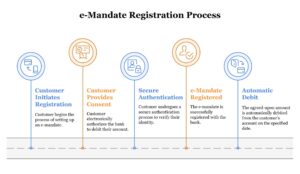
e-mandate registration refers to a customer granting authorisation to a bank or financial institution to initiate regular debits from their account. To set up an e-mandate, customers must provide their consent electronically through a secure authentication process. Once registered, the designated amount is automatically debited from the customer’s account on the specified date, as per the agreed-upon terms and conditions.
e-Mandate for Loan Repayments
e-mandate makes loan repayments simpler by offering a convenient and efficient way for borrowers to fulfil their repayment obligations. Whether it’s a personal loan, home loan, or any other form of credit, borrowers can set up e-Mandates to ensure timely repayment of MSME loan EMIs without the risk of missing deadlines or incurring late fees. This automated process simplifies loan management for both borrowers and lenders, reducing administrative burdens and ensuring compliance with repayment schedules.
Also Read: What is VPA, Full Form, Meaning in UPI?
Eligibility Criteria For e-Mandates
While e-mandates offer numerous benefits, certain eligibility criteria must be met to set up and use e-mandates effectively:
1. Active Bank Account:
To initiate an e-mandate, the customer must hold an active bank account with the issuing bank. An active account ensures that funds can be seamlessly debited for recurring payments without any hindrance. Customers need to maintain their accounts in good standing to avoid disruptions in e-mandate transactions.
2. Consent for e-mandate Registration:
Customers are required to provide explicit consent for e-mandate registration through a secure authentication process. This authentication process typically involves verifying the customer’s identity through personal credentials, such as passwords, PINs, or biometric authentication. By obtaining consent, banks and financial institutions ensure that customers willingly authorise the initiation of recurring payments from their accounts.
3. Authorisation of Merchant or Service Provider:
The merchant or service provider initiating the e-mandate transaction must be authorised by the bank to facilitate such transactions. This authorisation ensures that only legitimate and trusted entities can initiate e-mandate transactions on behalf of customers. Banks verify the credentials and compliance of merchants to safeguard customer interests and prevent fraudulent activities.
4. Compliance with Regulatory Guidelines:
E-mandate transactions must adhere to regulatory guidelines and security standards to protect customer data and privacy. Regulatory authorities, such as the Reserve Bank of India (RBI), impose strict regulations to ensure the integrity and security of electronic transactions. Banks and financial institutions must comply with these regulations to safeguard customer information and prevent unauthorised access or misuse of e-mandate data.
By meeting these eligibility criteria, customers can set up and utilise e-Mandates effectively, ensuring smooth and secure processing of recurring payments while maintaining compliance with regulatory requirements.
Lendingkart’s user-friendly online platform allows for efficient loan applications, document management, and tracking of loan progress. This frees up valuable time for business owners to focus on core operations and strategic growth initiatives, empowering them to run their businesses more efficiently and effectively.
Frequently Asked Questions:
1. What is an e-mandate?
An e-mandate is an electronic authorization given by a customer to a bank or financial institution to debit funds from their account for recurring payments. It enables automated transactions, simplifying payment processes for both businesses and consumers.
2. What are the new RBI guidelines for e-mandate?
The Reserve Bank of India (RBI) has issued guidelines to enhance the security and efficiency of e-mandate transactions. Starting from 1 October 2021, there will be a restriction on automatic recurring payments in India, with transactions limited to ₹5000 per transaction.
All current subscriptions will need to be re-registered through a one-time process that involves Additional Factor Authentication (AFA) from the customer’s issuing bank.
3. What is the difference between eNACH and E-Mandate?
eNACH (Electronic National Automated Clearing House) is a system used for bulk electronic transactions, including e-mandate processing. e-Mandate refers specifically to the electronic authorization given by a customer for recurring payments, while eNACH facilitates the processing of these mandates in a secure and automated manner.
4. Why is the mandated amount more than EMI?
The mandated amount may be higher than the EMI (Equated Monthly Installment) to account for additional charges such as processing fees, interest, or other applicable fees. Customers need to review the terms and conditions of the mandate carefully to understand the total amount being debited from their account.
5. What is the maximum amount of e-mandate?
The maximum amount of an e-mandate depends on the policies of the issuing bank and regulatory guidelines. Some banks may impose limits on the maximum transaction amount for e-mandates to reduce risk and ensure financial security for customers.
Related Articles

eNACH vs eMandate: Difference
Understand the key differences between eNACH and eMandate, their features, advantages, and applications in recurring payments.

What is UTGST?
Learn everything about UTGST, its applicability, tax structure, and how it functions in Union Territories of India.

Business Finance
Explore various aspects of business finance, including funding options, financial planning, and management strategies for enterprises.