

With developments happening at a rapid pace, businesses today are operating in an ever-evolving environment shaped by various internal and external factors. This environment is one of the most important aspects determining the success and sustainability of a business organisation.
If you are a business owner or plan to start one soon, understanding the business environment is key. Once you are well aware of the importance of the business environment, you can develop unique strategies to mitigate risks, increase revenue and leverage opportunities more effectively.
In this comprehensive guide, we will delve into this concept and explore the types and features of business environments.
Introduction to Business Environment
Academically, the term business environment refers to internal and external factors that directly and indirectly influence an organisation’s operations, strategies and performance. These factors can be anything from company culture and leadership to wider economic conditions and government regulations.
In a more practical sense, the term business environment refers to a dynamic setting within which an organisation operates. Although the academic and practical definitions of the term might appear different, the underlying meaning remains the same – all business organisations operate in an ever-changing background.
One of the notable aspects is that the various business environment factors affect industries differently. Let us take the retail industry, for example. External business environment factors like changes in consumer behaviour and digitisation often have an immense impact on sales. On the other hand, supply chain disruptions and technological advancements matter more for the manufacturing industry since they can directly impact production efficiency.
Features of Business Environments
Now that you have an understanding of the business environment, let us explore some of the key features that make it crucial for organisations to analyse and adapt to it for long-term success.
- Evolving Nature
One of the key characteristics of business environments is that they are dynamic and ever-changing due to technological advancements, changes in consumer preferences and fluctuations in the economy. Organisations must keep pace with these changes and adapt their strategies accordingly to remain competitive and enjoy long-term success.
- Interrelation of Factors
Contrary to popular opinion, the various internal and external business environment factors are interconnected. For example, a change in economic policy could affect consumer behaviour, which can impact sales strategies. Organisations must understand how the different external and internal business environment factors are connected with each other to stay ahead of the curve.
- Complex and Unpredictable
Another one of the key features of business environments is that they can be highly complex to understand. This makes predicting outcomes due to changes in the environment highly challenging. Therefore, organisations must develop comprehensive risk management strategies to navigate unavoidable uncertainties due to market crashes, political instability or natural disasters.
- Global and Local Impact
No two business environments can ever be identical. For example, the Indian business environment is vastly different from, say, that of Sri Lanka. Therefore, organisations that operate on both local and global levels must customise their strategies to adapt to different economic, cultural and regulatory environments to succeed.
Importance of Business Environment
Every organisation must be aware of the important role that business environments play in their sustainability and long-term success. Here is a quick look at why businesses must pay attention to their environment.
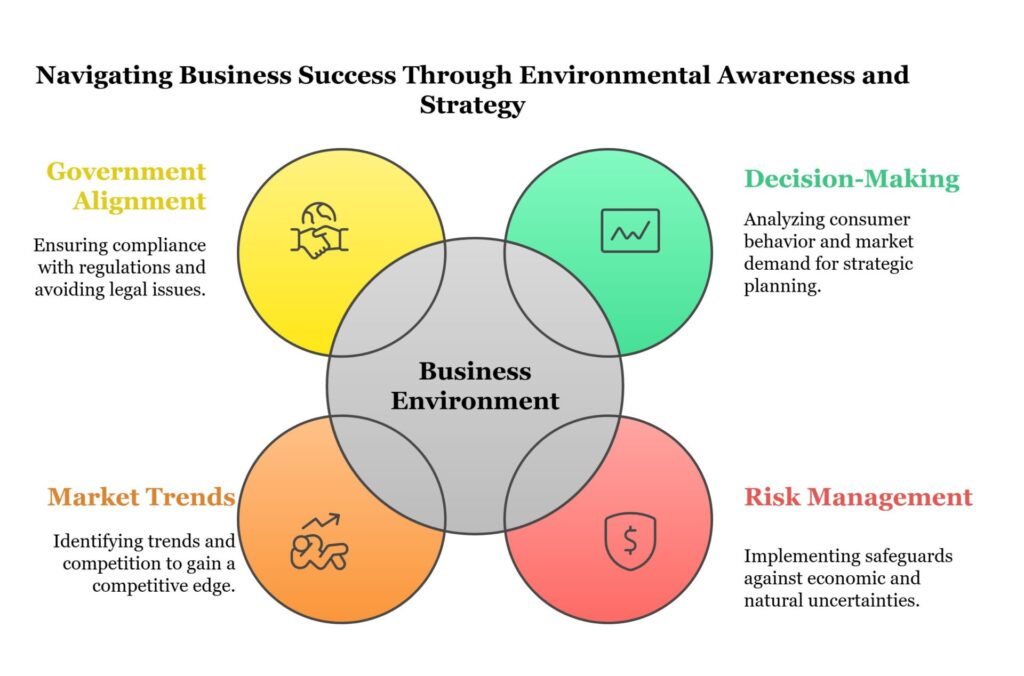
- Helps in Decision-Making and Strategic Planning
Organisations can gain crucial insights into consumer behaviour, market demand and economic conditions by analysing their respective business environments. These insights can then be used when formulating a business strategy or making key decisions.
- Assists Businesses in Risk Management
As you have already seen, the environment surrounding a business can be uncertain. Economic fluctuations, natural disasters and changes in the political landscape can deeply impact operations. By assessing their business environments periodically, organisations can implement operational and financial safeguards that protect them from various risks.
- Helps Identify Market Trends and Competition
Comprehensively analysing the business environment can help organisations unearth key market trends and competition. They can then use this information to fine-tune various elements of a business plan to gain an edge over their rivals.
- Enables Businesses to Align with Government Policies
Government regulations often form a large part of a business environment. By staying updated on taxation, labour laws, environmental policies and trade restrictions, organisations can enhance compliance and avoid legal consequences.
Types of Business Environments
Business environments can be broadly categorised into two major types: internal and external. Let us explore both of these types in detail.
- Internal Business Environment
The internal business environment refers to factors within an organisation that influence its operations and decisions. These factors can be controlled, managed and optimised to a large extent by businesses. Some of the key components of an internal business environment include the following:
- Leadership
- Company culture
- Employees
- Infrastructure
- Financial resources
A strong internal business environment enables organisations to remain competitive, adapt to industry changes and achieve long-term success.
- External Business Environment
The external business environment refers to factors outside an organisation that influence its operations and decisions. These factors cannot be controlled since they are often unpredictable and constantly evolving.
The external business environment can be further subdivided into two categories: micro-environment and macro-environment. Here is a brief overview of both of these two sub-types.
- Micro-Environment
The micro-environment consists of immediate external factors that directly impact an organisation’s day-to-day operations. These factors are often industry-specific and can vary from one business to another. Some of the micro-environment factors include the following:
- Competitors
- Suppliers
- Customers
- Intermediaries
- Media and news outlets
- Macro-Environment
The macro-environment consists of broader external factors that impact businesses across industries. These factors often tend to be common for most businesses, even if they operate in different sectors. Some of the macro-environment factors include the following:
- Economic conditions
- Social factors
- Political and legal factors
- Technological factors
- Environmental factors
Key Components of Business Environments
Every business environment has certain key components that organisations must be aware of. Understanding these components can help them formulate business growth strategies more effectively.
- Economy
Economic factors like inflation and interest rates directly impact the profitability of a business and can influence the various decisions that it makes. For example, if an economy is struggling with high inflation, sales could be affected for businesses operating within such an environment due to a decline in purchasing power.
- Political and Legal Landscape
One of the most important components of a business environment that is often neglected is the political and legal landscape. Political stability enhances investor confidence and can greatly influence business development. Similarly, government regulations with regard to taxation, labour laws and trade also shape business operations.
- Social Landscape
The social landscape is often a misunderstood component of a business environment. Cultural trends, changing demographics and consumer behaviour are major social factors that organisations must take into account when formulating business growth strategies.
- Technological Landscape
Technological advancements like artificial intelligence (AI) and machine learning (ML) are transforming the way businesses operate. By investing in the latest technology, organisations can improve operational efficiency and customer satisfaction.
- Natural or Environmental Landscape
Environmental awareness is increasing among the public. Even governments have started to recognise the impact on the environment and are imposing strict regulations. To succeed in the long term, businesses must adopt eco-friendly and sustainable initiatives. This will also help them appear more attractive to environmentally cautious consumers and avoid regulatory issues.
- Competition
The competitive landscape is another very important component of a business environment. Therefore, organisations must continuously analyse their competitors and differentiate their offerings to stay ahead. A highly competitive environment can push companies to enhance quality, customer service and pricing strategies.
Examples of Business Environment in Action
Let us now look at a few practical examples to gain a better understanding of the business environment.
- Example 1: The impact of government policies on the banking sector
Organisations operating within the banking sector are highly susceptible to changes in government policies.
For example, let us assume that the government increases the Cash Reserve Ratio (CRR). As a result of this change, banks will now have to retain higher capital reserves to ensure financial stability.
However, this will lead to certain challenges like less availability of capital for lending and impact the banks’ revenue streams.
A potential solution to this could be in the form of diversification of revenue streams by focusing on other banking areas to compensate for the loss in income due to reduced lending opportunities.
- Example 2:The impact of technology on e-commerce businesses
E-commerce is deeply linked to the technological environment. Artificial intelligence, data analytics and machine learning are all cutting-edge technologies that can enhance e-commerce businesses.
For example, an e-commerce company can leverage AI, ML and data analytics to curate a personalised experience for its customers based on their spending patterns and preferences. Providing such a tailored experience can help them drive sales and increase revenues. Meanwhile, companies that fail to adopt this technology risk falling behind their competitors.
- Example 3: Social trends influencing the fashion industry
The fashion industry is cyclic and has always been dependent on consumer preferences. A growing trend, of late, is sustainability and ethical consumerism. Consumers are becoming more environmentally conscious and prefer brands that promote sustainable sourcing, ethical labour practices and eco-friendly materials.
Businesses in the fashion industry must move away from fast fashion and incorporate sustainable fabrics and transparent supply chains to gain popularity among consumers. They can also consider eco-friendly initiatives like eliminating plastic packaging and implementing a clothing recycling program to drive interest and sales.
Challenges Businesses Face Due to Changing Environments
Most organisations are forced to face multiple challenges due to the dynamic nature of business environments. Let us explore some of the key threats that businesses face.
- Economic Downturns and Inflation
During periods of high inflation and economic downturns, the purchasing power of the public declines. This leads to lower demand for non-essential goods and services, poor sales and business profitability.
- Regulatory Compliance and Changing Government Policies
Changes in regulatory guidelines and policies often create uncertainty. If businesses are not quick to adapt to these changes, they may face poor financial performance.
- Market Competition and Technological Disruptions
The rise of new competitors, coupled with rapid technological advancements, can often push businesses out of the market. To prevent such disruptions from affecting their businesses, organisations must continuously innovate to stay ahead of emerging trends and competition.
- Environmental and Sustainability Concerns
With an increasing global focus on climate change and sustainability, businesses that do not reduce their environmental impact are likely to suffer from poor performance. Organisations must work to align with global sustainability goals, reduce carbon footprints and promote responsible business practices to enjoy long-term success.
How Businesses Can Adapt to the Changing Business Environment
Evolving business environments need not always be a disadvantage for organisations. By implementing carefully thought-out business development plans, businesses can successfully adapt themselves. Here are a few corporate strategies that can help.
- Conducting Market Research and Trend Analysis
Market research and trend analysis are crucial to understanding consumer preferences and competitor strategies. Regular research can help businesses anticipate changes in the industry and adjust strategies accordingly, which are essential for success.
- Leveraging Technology for Digital Transformation
Digital transformation enhances operational efficiency, customer engagement and market reach. By embracing automation, AI and data analytics, businesses can improve decision-making, customer engagement and sales.
- Implementing Sustainable and Ethical Business Practices
Sustainability and ethics are essential for modern businesses to gain customer trust and regulatory compliance. Businesses can build strong brand loyalty and comply with environmental regulations by simply focusing on sustainability and ethical practices.
- Developing Agility and Resilience in Business Strategies
A business strategy that is inflexible will no longer work. Organisations must be adaptable in their approach as it would allow them to respond quicker to market changes and mitigate risks more effectively.
Conclusion
The business environment is a dynamic and complex framework that directly impacts an organisation’s ability to grow. Businesses must stay constantly updated on the latest industry trends and technological developments to thrive in this ever-changing landscape.