

Starting a business in India is both exciting and challenging. While the government’s Startup India initiative provides support through tax incentives, simplified compliance, and IPR fast-tracking, securing funding remains crucial. Entrepreneurs need to know and understand the different ways to raise capital for a company. Establishing a solid business strategy and understanding funding requirements are key steps in navigating India’s dynamic entrepreneurial landscape.
How Does Startup Funding Work?
The mechanics of startup funding in India involve a delicate balance between entrepreneurs and investors, centered around the exchange of capital for equity. When investors provide funds for business, they typically receive a proportionate ownership stake in the company. This arrangement entitles investors to a share of profits, aligning their interests with the startup’s success. However, it is important to note that this model also exposes investors to potential losses if the venture fails to meet expectations.
The funding journey for Indian startups often begins with a thorough company valuation. This process considers various factors such as the startup’s management team, market potential, risk factors, and projected profitability. A well-executed valuation sets the stage for fundraising rounds. This is typically with a seed round and progressing through Series, A, B, and C as the company grows. Throughout this process, startups must navigate the delicate balance of giving up equity while maintaining enough control to steer their vision forward in the competitive Indian market.
How to Raise Funds for Startup Business in India?
Securing funding for a startup in India requires careful planning and execution. Here are the key steps entrepreneurs can take to improve their chances of attracting investors:
- Calculate Your Funding Needs
Before approaching investors, it is crucial to have a clear understanding of how much capital is required to achieve specific business milestones. This involves creating detailed financial projections and understanding the runway provided by different funding amounts. For smaller funding needs, entrepreneurs might consider business loans or grants. On the other hand, larger capital requirements may necessitate approaching angel investors or venture capital firms.
- Create Business Plan
A well-structured business plan outlines the startup’s vision, market potential and competitive edge. Investors assess scalability, financial projections and industry relevance before committing funds.
- Check Financial Status
Maintaining updated financial records, such as tax returns and cash flow statements, is crucial for credibility. Startups should also comply with Indian accounting standards to build investor confidence.
- Research Funding Options
Entrepreneurs should explore various funding options, from government schemes to venture capital. Networking at startup events and joining incubator programs can open opportunities to raise money for business.
- Make a Repayment Plan
For startups relying on loans, a structured repayment plan ensures financial stability. A clear strategy reassures investors and fosters long-term trust with financial institutions.
Three Primary Sources of Funding for Businesses
In India’s diverse startup ecosystem, entrepreneurs have access to various funding options, each suited to different stages of growth and business models. These funding types can be broadly categorized into three main categories:
Equity Funding for Startups
Equity funding involves selling a portion of the company’s ownership in exchange for capital. This type of funding is popular among high-growth startups in India and includes:
- Angel investors
- Venture capitalists
- Self-financing or bootstrapping
- Family and friends
- Crowdfunding
- Incubators
Debts Funding for Startups
Debt funding involves borrowing money that must be repaid with interest. This option allows startups to raise capital without diluting ownership:
- Banks
- Non-banking financial institutions (NBFCs)
- Government loan schemes
Grants for Startups
Grants provide non-dilutive funding that does not require repayment, making them highly attractive to startups:
- Central government grant
- State government grant
- Corporate government grant
- Programs of private entities
Types of Funding for Startups
There are different types of funding processes for a business. Some of the most common types in India are as follows:
- Government Schemes
The Indian government has recognized the importance of startups for innovation and economic growth. It has led to the introduction of various loan schemes to support new enterprises. These schemes cater to diverse segments, including women entrepreneurs, educated youth, and those from rural areas. It aims to boost the overall entrepreneurial ecosystem.
Some of the prominent government-backed schemes include the Pradhan Mantri Mudra Yojana and Startup India Seed Fund among others. Entrepreneurs should explore these schemes and leverage the financial, infrastructural, and regulatory support offered by the government.
- Bank Loans
Traditional banks provide startup loans and working capital loans based on creditworthiness and business plans. While the process is lengthy, it allows entrepreneurs to retain full ownership and secure stable funding. To increase approval chances, startups should maintain strong financial records and compelling business cases.
- Non-Banking Financial Companies (NFBCs)
NBFCs offer flexible funding options for startups with quick processing, minimal documentation and customised loan products. They evaluate a startup’s growth potential rather than your key credit history, making funding accessible to new businesses.
For example, Lendingkart, a prominent NBFC in India, specializes in offering loans for micro, small, and medium businesses. It helps startups access the funds they need to grow without any constraints.
- Angel Investor
Angel investors fund early-stage startups in exchange for equity, focusing on innovative ideas with strong market potential. Building direct relationships with angel investors can help startups secure funding without rigid lending requirements. A well-prepared pitch and proof of concept can improve the chances of attracting such investors.
- Venture Capitalists
Venture capitalists (VCs) invest in high-growth startups, offering capital in exchange for equity and long-term strategic partnerships. They focus on scalable business models with strong leadership teams and clear growth potential. Startups seeking VC funding must have a solid business plan and be prepared for rigorous due diligence.
- Strategic Partnerships
Established companies collaborate with startups to provide financial resources, technology or market access in mutually beneficial agreements. These partnerships accelerate growth by leveraging the strength of both parties.
- Startup Incubators and Accelerators
These programs provide mentorship, resources and funding in exchange for equity, helping startups scale quickly. They also offer networking opportunities, legal support and workspace solutions. Entrepreneurs should research incubators aligned with their industry to maximise benefits.
- Grants & Competitions
Participating in startup grants and competitions can offer non-dilutive funding and industry recognition for startups. Winning such opportunities enhances the startup’s credibility and can attract further investment. The application process, however, can be highly competitive and time-consuming, and entrepreneurs must carefully review the grant agreement to ensure alignment with their goals.
- Investments from Close Network
Friends, family and acquaintances can provide initial funding based on trust and belief in the startup’s vision. This funding is often flexible but requires clear legal agreements to avoid personal conflicts. Maintaining transparency and setting clear repayment terms can build long-term credibility.
- Crowdfunding
Crowdfunding is a method of raising funds from multiple investors through social media platforms and web-based portals. This democratized startup funding model can bring validation and a diverse investor base. In India, several online platforms like Milaap, GoCrowdera, and Indiegogo facilitate crowdfunding for various purposes. It includes startups, social causes, and disaster relief.
- Bootstrapping (Self-Financing)
Using personal savings to fund a startup avoids debt and allows founders full control over decisions. This approach promotes financial discipline and long-term sustainability. While it limits rapid expansion, it ensures the business grows on solid financial footing.
- Freelancing
Entrepreneurs can fund their startups by offering freelance services in their domain of expertise. This provides immediate income, which can be used to finance the startup’s initial stages, while also allowing for skill development. However, balancing freelancing and building a startup can be challenging. This is because there is a risk of diverting focus from the core of the business.
- Business Loan
Startups can apply for a small business loan to secure either working capital or term loans based on their financial needs. Lenders evaluate factors like credit score, business viability and repayment capacity before approving the loan.
- Small Business Grants
These government or private grants provide capital to cover operational expenses to raise capital for small businesses. Unlike loans, grants don’t require repayment, making them a valuable way to raise capital for startups without financial burden.
Stages of Startup Funding
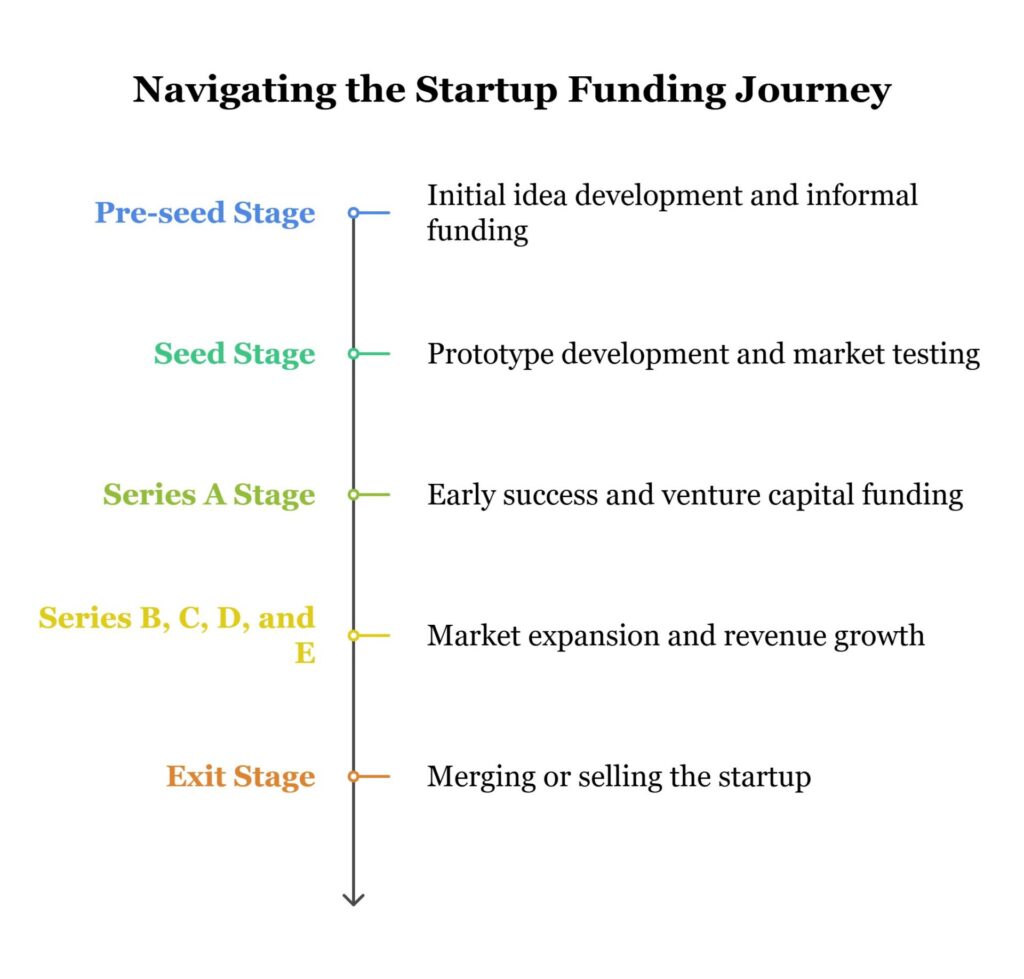
The journey of a startup involves various stages, each with its funding requirements. Understanding these stages and the appropriate funding sources for each can help entrepreneurs navigate the startup funding landscape effectively.
- Pre-seed Stage
In the pre-seed stage, entrepreneurs develop the initial business idea and work to establish the startup. At this stage, the funding needs are relatively small, making informal sources like friends, family, and personal savings (bootstrapping) the most suitable options. Grants and competitions can also provide non-dilutive funding to kickstart the venture.
- Seed Stage
During the seed stage, entrepreneurs have a prototype or proof of concept (POC) and are focused on establishing the product’s potential demand. This is the stage where incubators, government schemes, angel investors, and crowdfunding platforms can be valuable sources of funding. These sources can provide the necessary capital to launch the product in the market and gather initial customer data.
- Series A Stage
In the Series A stage, the startup has achieved early success, with performance indicators like a growing customer base, app downloads, monthly recurring revenue, and active users. This stage is suitable for obtaining funds from venture capitalists, and banks. The funding secured can be used to improve product development, expand the customer base, and establish new branches or divisions.
- Series B, C, D, and E
As the startup progresses, it enters the later stages, where it has established a stable position in the market and is generating better revenue. These stages require funding to further develop the business. It includes actions like devising new marketing strategies, hiring new employees, forming teams, and building new departments. Venture capital firms and investment forms become the primary sources of funding at these stages. This is because the startup has demonstrated its growth potential and market viability.
- Exit Stage
The final stage of a startup’s lifecycle is the exit stage, where the entrepreneur either merges the startup with another company or sells the business to a larger organization for a profit. This stage may involve an Initial Public Offering (IPO) to sell shares to the public. It provides the startup with additional funds for further growth and expansion.
How to Get Funding for Startups in India from the Government?
Various government schemes in India can help a startup with its required funding. Some of the government schemes and funding options are:
- Pradhan Mantri Mudra Yojana
- SIDBI Fund of Funds Scheme
- Equity Fund Scheme
- Samridhi Fund
- Startup India Seed Fund Scheme
- Rupee Term Loan (RTL)
- Stand Up India
- Micro Finance (NEDFL Scheme)
What Do Investors Look for in Startups?
- Objectives and Problem Solving: Investors seek startups that solve a unique problem with differentiated offerings. A strong value proposition attracts business investors and enhances funding potential.
- Market Landscape: Investors assess market size, growth potential and competitive positioning before they get funding for your business to ensure scalability.
- Management and Team: The passion, expertise and leadership of the foundation team play a key role in securing startup capital as investors value capable management.
- Customers and Suppliers: A startup should demonstrate a clear path to scale with a stable business model to attract capital funding and long-term business funding options.
- Scalability and Sustainability: A startup should demonstrate a clear path to scale with a stable business model to attract capital funding and long-term business funding options.
- Competitive Analysis: Investors evaluate competition, market share and barriers to entry before committing money to start a business in a particular sector.
- Financial Assessment: A detailed financial model with revenue projections, break-even analysis and funding needs helps investors calculate potential small business loan rates and ROI.
- Sales and Marketing: A solid sales strategy with defined target audiences and conversion metrics is crucial for raising capital for a startup successfully.
- Exit Avenues: Investors look for clear exit strategies, such as IPOs, acquisitions or buybacks before providing non dilutive funding to a startup.
Why Do Investors Invest in Startups?
Investors provide startup business loans or direct capital in exchange for equity. If the company succeeds, they earn returns proportionate to their stake; if it fails, they bear the loss.
- Mergers and Acquisitions: Selling the startup to a larger company offers an exit for investors who provided business capital.
- IPO: A startup going public allows investors to cash out and earn returns on their business loan apply online funding.
- Selling Shares: Investors may transfer their equity to other small business investors or financial firms.
- Distressed Sale: If a startup struggles financially, investors might sell their stake to recover their working capital business loan contributions.
- Buybacks: Founders can regain ownership by repurchasing shares if they accumulate enough, getting fund liquidity.
Conclusion
Securing funding is a critical step in transforming a business idea into a reality. Entrepreneurs in India have access to diverse ways to raise funds, from government grants and bank loans to angel investors and NBFCs like Lendingkart. By understanding the various financing avenues and aligning them with their business needs and growth stage, startups can strategically choose the best approach to secure the necessary capital. Leveraging the right funding source fuels growth as well as positions the business for long-term success. With determination and the right financial backing, entrepreneurs can turn their vision into successful businesses.
Frequently Asked Questions
1. What are the most common ways to raise capital for a startup in India?
* Equity Funding: Angel investors, venture capitalists, crowdfunding, family/friends, and incubators.
* Debt Funding: Bank loans, NBFC loans (e.g., Lendingkart), government-backed schemes like PMMY or SIDBI.
* Grants: Non-repayable funds from government initiatives or private competitions. Other methods include bootstrapping, freelancing, strategic partnerships, and startup accelerators.
2. How much funding should I raise for my startup initially?
* Define your business milestones (e.g., MVP launch, market entry, hiring).
* Estimate operating expenses and marketing budgets for at least 12–18 months.
* Choose a funding amount that balances your growth needs without excessive dilution or debt burden. Use your business plan and projections to justify the funding requirement to lenders or investors.
3. What funding options are available through the Indian government for startups?
* Pradhan Mantri Mudra Yojana (PMMY)
* Startup India Seed Fund Scheme
* Stand-Up India Scheme
* SIDBI Fund of Funds
* Equity Fund and Samridhi Fund These schemes aim to promote innovation, employment, and entrepreneurship with easier loan access and non-dilutive capital.
4. What do investors look for before funding a startup?
* Unique problem-solving potential and market opportunity
* Strong founding team and leadership
* Scalability and sustainability of the business model
* Clear financial projections and ROI potential
* Defined exit strategies such as IPO, acquisition, or buyback
* Credibility in operations through proof of concept or traction (revenue, users, product validation)
5. Is crowdfunding a viable option for Indian startups?
* A compelling story or social cause
* Strong community support
* A consumer-facing product or service that can build early excitement
Related Articles

How to Start a Business
Step-by-step guidance on launching your own business, from idea validation to registration and funding.

Business Loan to Start a Business
Explore various business loan options, eligibility criteria, and tips to secure funding for your startup.

How to Start DSA Business
A guide on starting a Direct Selling Agent (DSA) business with tips on registrations, partnerships, and commissions.