

Credit cards have completely transformed the way Indians make payments. However, many remain unaware of how their credit card bill payment habits affect their credit scores. Quite a few credit card holders, even today, simply resort to just paying the minimum payment to avoid penalties.
While this might be okay during emergencies, continuing this practice for a long time can have detrimental effects on financial health and credit scores. In this article, we will explore the concept of minimum payments on credit cards and how they impact your credit scores. Furthermore, we will also explore the various strategies that you can follow to improve your score while managing credit card payments.
What is the Minimum Payment Due on Credit Cards?
The minimum payment due, also known as the minimum amount due (MAD), is the lowest amount that a credit card holder must pay on or before the due date to avoid late payment charges.
The MAD is typically calculated as a percentage of the total amount spent during a billing cycle plus applicable fees and EMIs. Here is a hypothetical example explaining how the minimum payment due on a credit card works.
Assume you have purchased products worth ₹10,000 on your card in the month of January 2025. You have an ongoing EMI of ₹2,500 and the card provider has also levied an annual fee of ₹1,500 (including taxes).
Now, according to the bank’s policy, the MAD percentage is 5%. Going by this, the minimum payment due for the January 2025 billing cycle would be ₹4,500 [(5% x ₹10,000) + (₹2,500 + ₹1,500)]
Failing to pay at least your card’s minimum payment amount will result in a penalty for non-payment, interest on the total amount due and a negative impact on your credit score.
How Minimum Payments Impact Your Credit Score
Several factors are considered when determining your credit score. Two of the most important ones are – the payment history and the credit utilisation ratio.
When you pay the minimum amount due on your card, your payment history is not impacted in any way. The card issuer will still consider it as an on-time payment.
However, since the bank will levy interest on the unpaid amount, your credit utilisation ratio will increase as a result. A rising utilisation ratio will significantly impact your credit score, especially if it crosses 30%. For instance, if your credit card has a total credit limit of ₹1 lakh, your credit utilisation ratio must ideally not cross ₹30,000 (30% x ₹1 lakh).
Now, if you only pay the minimum amount due on your card for a few months, you will continue to incur interest on the initial unpaid amount plus all the interest, fees and taxes levied on it. Meanwhile, your credit utilisation ratio will keep increasing, negatively impacting your score each month.
This will not only lead you to a credit card debt trap but also make you ineligible to avail of loans and other credit facilities. This cascading effect will continue until you clear all your dues with interest and other charges.
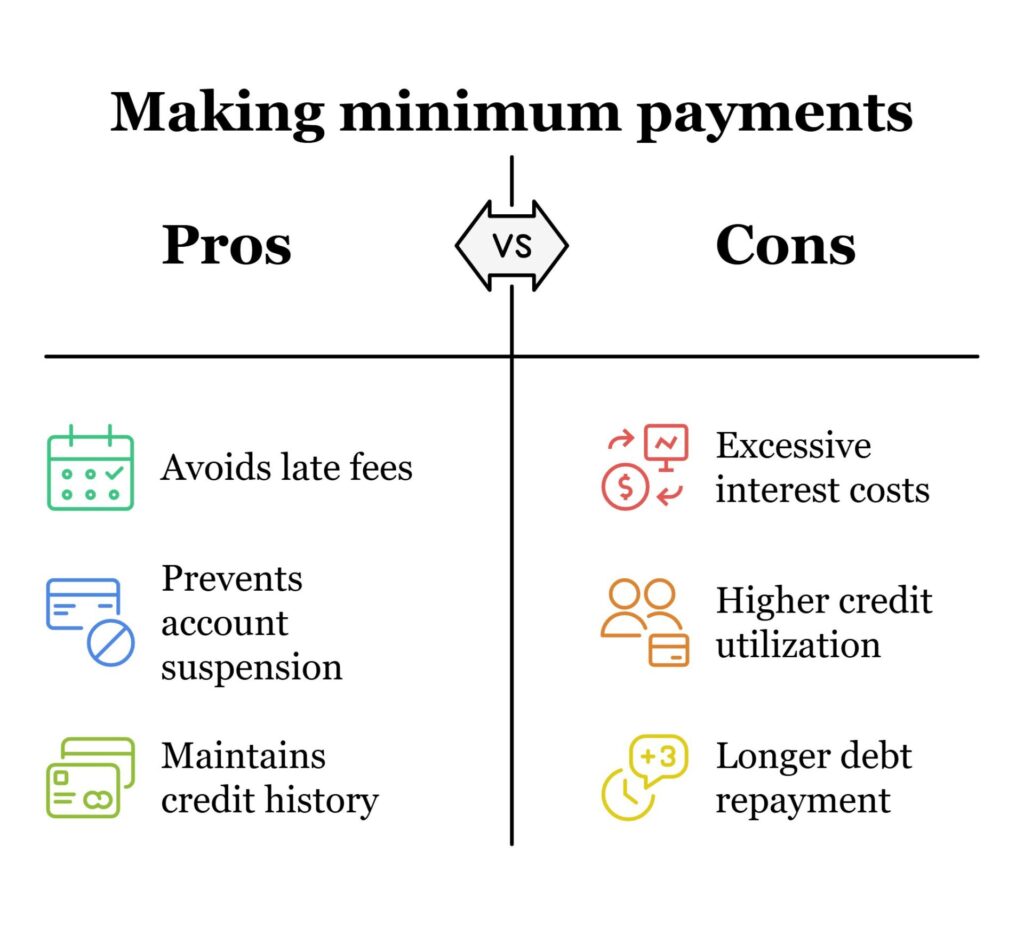
Pros and Cons of Making Minimum Payments
Paying just the minimum amount due on a credit card has both advantages and disadvantages. Knowing what they are can help you manage your finances better and be more responsible. Here is a more in-depth overview of the benefits and drawbacks of this habit.
Advantages of Paying the Minimum Amount Due
- Avoids Late Fees
If you fail to pay your credit card dues on or before the due date, the card provider will levy a late fee. The late fee is usually calculated based on the total amount due. This essentially means that the higher the outstanding card balance, the higher the late fee shall be. However, by paying the minimum due on your card, you can prevent such late penalties and negative impacts on your credit score.
- Prevents Account Suspension
When you fail to make even the minimum payment due for a few months, your card issuer will suspend your credit card account. However, by making the minimum payment, you can keep your credit card account active and continue to use it.
- Maintains Credit History
Your payment history remains intact when you pay the minimum amount due on or before the due date. This not only avoids an immediate negative impact on your score but also contributes positively to the length of your credit history.
Disadvantages of Paying the Minimum Amount Due
- Leads to Excessive Interest Costs
When you pay only the minimum payment due, you carry the majority of your outstanding card balance plus interest over to the next billing cycle. Carrying balances over time can quickly lead to excessive interest charges and lead you towards a debt trap.
- Increases the Credit Utilisation Ratio
As you have already seen, making just the minimum payment will increase the credit utilisation ratio, which can reduce your credit score.
- Takes Longer to Repay Credit Card Debt
Since the credit card interest charges are high, paying just the minimum due for a few months accumulates excessive interest. This can increase your debt and extend the time required to pay off the debt completely.
Strategies to Improve Credit Score While Managing Payments
Managing credit card bill payments and your credit score at the same time might seem challenging, especially if you are a new credit card user. Fortunately, with the following strategies, you can easily improve your score and keep your payments in check.
- Make Payments on Time
To improve your credit score, you must always aim to pay the total amount due on your card on or before the stipulated due date. If you are someone who tends to miss credit card bill payments, consider setting up automatic payments or reminders. This way, you can safeguard your payment history by never missing a due date.
- Pay More Than the Minimum
If you are unable to pay the entire outstanding card balance due to financial emergencies, at least aim to pay more than the minimum payment due. Even small additional payments beyond the minimum can reduce interest costs and the impact on the credit utilisation ratio.
- Reduce Credit Utilisation
Reducing your credit utilisation to below 30% can significantly improve your credit score. You can do this by making larger payments or requesting your card issuer to increase your credit limit.
- Monitor Your Credit Report
Sometimes, the credit report may contain errors, mistakes or omissions that can reduce your score. As a responsible user, you must regularly check your score and your credit report. This way, you can identify errors and get them rectified immediately, before they cause a negative impact.
Common Myths About Minimum Payments and Credit Scores
Even today, many credit card users have misconceptions about how minimum payments impact their credit scores. In this section, we will debunk a few of the common myths that many still believe.
- Myth 1: Making the Minimum Payment Impacts the Payment History
Paying just the minimum amount on your card before the due date will not impact your payment history. This is one of the many reasons why most credit card users prefer making the minimum payments to keep their accounts active and intact.
- Myth 2: Making the Minimum Payment Will Immediately Reduce the Credit Score
Contrary to popular opinion, paying the minimum due will not reduce the credit score right away. However, if you continue to make minimum payments over time, it will negatively impact your score by increasing the credit utilisation ratio.
- Myth 4: Making Only Minimum Payments Does Not Affect Borrowing
While minimum payments might prevent default, they will still be displayed on your credit report and during loan score checks. Potential lenders might view this unfavourably and make it harder to obtain loans and credit facilities in the future.
Conclusion
Making only the minimum payment on your credit card can keep your account active and prevent late fees. However, credit card providers will levy interest on the unpaid outstanding card balance. This could quickly lead to a debt trap, with interest being levied on interest, especially if you continue this habit. Moreover, it will also reduce your credit score significantly by increasing your credit utilisation ratio.
If you wish to maintain a strong credit profile and improve your score, it is advisable to pay the total amount due on or before the stipulated due date. Or, at the very least, aim to pay more than the minimum to keep the utilisation ratio in control. This way, you can ensure long-term financial stability and a healthy credit score.
Does paying only the minimum amount on a credit card affect my credit score?
Is it okay to make minimum payments in an emergency?
How does credit utilisation ratio impact credit score?
What are the risks of making only minimum payments regularly?
How can I improve my credit score while managing credit card payments?
Related Articles

How Business Loans Affect Your Personal Credit Score
Understand how availing a business loan can impact your personal credit score and the steps to manage both effectively.

Maintaining a Good Credit Score for Your SME
Explore proven ways to maintain and improve your SME’s credit score for better financing opportunities.
Is a 900 Credit Score Possible?
Learn whether a perfect 900 credit score is achievable, how it’s calculated, and what benefits it offers to borrowers.