
No Cost EMI transforms the way consumers make purchases by removing the stress of extra interest fees. It offers individuals a flexible and convenient way to access products or services while dividing the cost into manageable installments. Unlike typical installment plans that accumulate interest on the remaining balance, No Cost EMI guarantees that buyers only pay the original price of the item without any interest costs. This is especially helpful for those businessmen looking for an affordable MSME business loan option.
What is No Cost EMI?
No Cost EMI, commonly known as Zero Cost EMI, offers a solution to consumer financing by allowing individuals to acquire goods or services without paying interest charges. This unique payment method enables customers to divide the total cost of their purchases into convenient fixed monthly installments. By spreading out payments over a set period, consumers can effectively manage their expenses and make significant purchases without experiencing immediate financial pressure. This empowers individuals to meet their needs and wants without taking on extra financial responsibilities.

How does No Cost EMI work?
The mechanism of No Cost EMI entails dividing the total purchase amount into equal installments payable over a specified duration. Unlike conventional EMIs that involve interest charges, with Zero Interest EMI, the interest component is absorbed by the seller or financing entity. Consequently, buyers only pay the actual price of the product or service in installments.
Also Read: EMI Calculation: Formula, and Tips for EMI Management
Is No-Cost EMI Actually No-Cost?
The truth is, the no-cost EMI isn’t entirely free. The interest cost is covered by either the seller, the card, the issuer, or the customer through adjustments in pricing, fees, or cashback. Here’s how:
- Interest paid by the customer, borne by the seller: The seller includes the interest in the product price and offsets it against the payable interest.
- Interest paid by the customer, borne by the card issuer: The card issuer charges a one-time transaction or processing fee.
- Interest paid and borne by the seller: The seller offers an upfront discount equal to the interest amount, making the EMI look interest-free.
- Interest paid and borne by the card issuer: The card issuer provides cashback equivalent to the interest.
- Mixed scenarios: In some cases, the seller offers a discount while the card issuer provides cashback, sharing the cost.
Since these adjustments exist, the question, “Does no cost EMI has interest” can be answered with yes. However, it is managed differently depending on who bears the cost. Additionally, customers should check for no cost EMI hidden charges, such as processing fees or foreclosures before opting for these plans.
When Should You Consider No Cost EMI?
Opting for no cost EMI loans can be beneficial in several situations:
- For Big Purchases: If you want to buy a high-value item like a TV, laptop, or smartphone but don’t want to pay the full amount at once, you can do no cost EMI card apply online to manage expenses better.
- If You’re Sure About Repayments: Since missing payments can lead to penalties, it’s important to take this option only if you can comfortably meet the monthly installments.
- When There is No Better Offer: If the seller isn’t providing an upfront discount or cashback, choosing an EMI plan allows you to spread the cost without additional interest.
- To Manage Your Cash Flow: Instead of making a lump sum payment, paying with this form of EMI ensures financial flexibility, keeping your monthly budget in check.
What to look out for while choosing No Cost EMIs
Before opting for No Cost EMI, it’s crucial to consider certain factors to ensure a well-informed decision:
1. Hidden Charges:
Some vendors may incorporate hidden fees or processing charges, potentially negating the benefits of No Cost EMI. Understanding the terms and conditions is essential to predict any unexpected costs.
2. Eligible Products:
Not all products or services may qualify for No Cost EMI. Buyers should confirm the availability of this payment option for their desired purchases.
4. Credit Card Limit:
No Cost EMI transactions are typically facilitated through credit cards. Hence, it’s important to ensure that the credit card has an adequate limit to accommodate the purchase amount.
5. EMI Tenure:
While longer EMI tenures may appear enticing owing to reduced monthly payments, they may lead to higher overall expenses. Opt for a tenure that aligns with your budget and financial objectives.
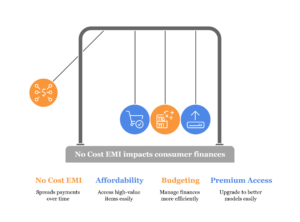
Pros for Choosing No Cost EMI:
1. Affordability:
Zero Cost EMI provides consumers with the opportunity to invest in high-value items without compromising their financial stability, enabling them to spread out payments and manage their budgets more effectively.
2. Convenience:
The convenience of Zero Interest EMI lies in its ability to offer flexible payment terms, allowing consumers to make purchases without the immediate financial burden of interest charges, thus enhancing their purchasing power and overall satisfaction.
3. Budget Management:
By breaking down the total cost of purchases into manageable installments, No Cost EMI assists consumers in planning their finances more efficiently, fostering disciplined spending habits and reducing the likelihood of financial strain in the long run.
4. Flexible Repayment Tenures:
Multiple EMI options available (3, 6, 9, or 12 months) allow customers to manage their finances better. This flexibility helps in maintaining cash flow without straining monthly budgets.
5. Access to Premium Products:
High-end items become more affordable on EMI, eliminating the need for full upfront payment. This makes it easier for buyers to upgrade to better models without financial burden.
Cons of Choosing No Cost EMI:
1. Limited Availability:
Despite its advantages, No Cost EMI may not be universally accessible, as not all vendors or products offer this payment option, potentially limiting consumer choice and forcing individuals to seek alternative financing methods.
2. Hidden Charges:
Consumers should remain vigilant and thoroughly review the terms and conditions of No Cost EMI agreements to avoid unexpected fees or charges, which could significantly inflate the overall cost of the transaction and undermine the perceived benefits of the payment plan.
3. Credit Card Dependency:
Zero Cost EMI transactions typically require a credit card, which may exclude individuals without access to credit or those who prefer alternative payment methods, posing a barrier to entry and limiting the accessibility of this financing option to certain segments of the population.
4. Reduced Cash Discounts:
Some retailers offer additional discounts on these EMIs, which otherwise buyers may miss out on. Over time, these missed discounts can add up, making EMI purchases slightly costlier.
5. Product-Specific Availability:
Not all products or sellers offer EMI schemes, limiting consumer choices. Availability often depends on partnerships between banks, card issuers, and retailers.
Also Read: EMI Loan Moratorium Interest Relief
Eligibility Criteria for Instant EMI Loan
To avail no cost EMI loans, applicants must meet specific eligibility criteria:
- Credit History: A strong credit score increases approval chances.
- Stable Income: Salaried, self-employed, pensioners, and business owners with consistent earnings are eligible.
- Age and Employment: Age requirements vary based on product type- consumer durables (21-65 years) and digital products (23-65 years).
- Nationality: Only Indian citizens can apply.
- Residence Area: The applicant’s residence should be in the same city as the store for in-store purchases.
If you’re planning to use an EMI card, check for pre-approved limits and eligibility before proceeding with your purchase.
Difference between EMI and No Cost EMI
While both EMI and No Cost EMI revolve around installment-based payments, the fundamental disparity lies in the interest component. Traditional EMIs require buyers to pay interest on the purchase amount, whereas No Cost EMI relieves consumers from this burden, with the interest charges being absorbed by the seller or financial institution.
Traditional lenders often require collateral for working capital loan, creating a hurdle for MSMEs with limited assets. Lendingkart breaks down this barrier by offering a variety of unsecured loan options. This eliminates the need for businesses to tie up valuable assets, allowing them to invest their resources directly into growth initiatives. Lendingkart’s focus on alternative credit assessment empowers MSMEs to unlock their full potential, even in the absence of traditional collateral.
Alternatives to No Cost EMI
If you prefer not to use this form of EMI, here are some alternatives:
- Full Payment Discounts: Many retailers offer special price cuts for customers who make full payments instead of choosing EMI. This can sometimes save more money than opting for EMi schemes.
- Credit Card EMIs: If EMI options available under no-cost EMI are limited, converting purchases into regular EMIs using a credit card is another choice. However, these typically come with interest.
- Personal Loans: Instant loans from lenders like Lendingkart can be useful for big-ticket purchases as compared to no cost loans, sometimes offering better rates.
Conclusion
Understanding No Cost EMI helps consumers make informed decisions while shopping or making purchases. While this option provides financial flexibility, buyers must be aware of potential hidden costs. For businesses looking to manage their finances better, Lendingkart offers smart funding solutions to take them to the next height.
Frequently Asked Questions:
1. What does No Cost EMI mean?
“No Cost Equated Monthly Installment” or No Cost EMI is a payment option that allows consumers to purchase products or services and pay for them in fixed monthly installments without incurring any interest charges. This model replaces traditional installment-based payments by eliminating the burden of interest, thus offering consumers a financially careful method to spread out their expenses over time.
2. What are the disadvantages of No Cost EMI?
Despite its advantages, No Cost EMI is not without its drawbacks. One significant limitation is its limited availability, as not all vendors or products may offer this payment option. This can potentially restrict consumer choice and force individuals to seek alternative financing methods for certain purchases.
Additionally, buyers should exercise caution to avoid hidden fees or charges associated with MSME Business Loan transactions, which could inflate the overall cost of the transaction and diminish the perceived benefits of the payment plan. Furthermore, the reliance on credit cards for No Cost EMI transactions may pose a barrier to entry for individuals without access to credit or those who prefer alternative payment methods.
3. Is No Cost EMI banned in India?
No, No Cost EMI is not prohibited in India. However, regulatory frameworks are enforced to ensure transparency and safeguard consumer interests. While No Cost EMI presents numerous advantages for consumers, regulatory oversight may be necessary to prevent deceptive practices and ensure that consumers are adequately informed about the terms and conditions of their financing arrangements.
4. Is No Cost EMI better than EMI?
The preference between No Cost EMI and traditional EMI arrangements depends on individual preferences and financial circumstances. No Cost EMI may be preferable for consumers seeking to circumvent interest charges and manage their finances wisely.
However, traditional EMI arrangements may offer more flexibility in terms of payment options and eligibility criteria. Ultimately, consumers should carefully consider their financial needs and preferences to determine which payment option best suits their requirements.
Related Articles
Loan EMI Calculation
Understand how to calculate your EMI for loans and plan your finances better with easy formulas and examples.
Impact of Business Loan EMI Bounce on Creditworthiness
Know how missing EMI payments can affect your credit score and business loan eligibility.

EMI Loan Moratorium, Interest Waiver & Cashback
Explore the relief options like EMI moratorium, interest waiver, and cashback benefits during financial crises.